
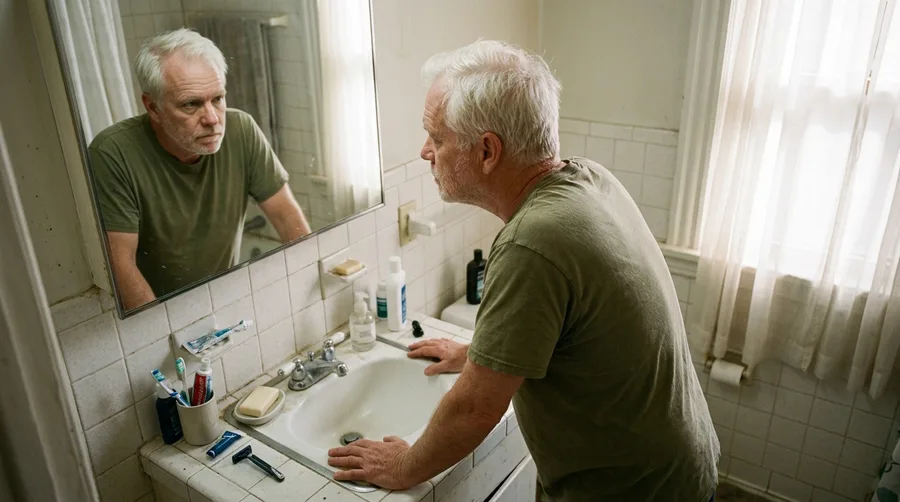
You did everything right, paid your bills, built a stable career, and yet you feel like an absolute alien at every social gathering. That profound, quiet isolation is often the lingering echo of an invisible past.
Childhood emotional neglect is not defined by what happened to you, but by what failed to happen when you needed attunement. When emotional validation is entirely missing, children learn to shrink their inner worlds to survive.
Everyday behaviors like chronic over-apologizing or extreme self-reliance are rarely quirky personality traits. They are precise survival adaptations forged in homes where emotional expression was a luxury.
⚠️ COMMON MISTAKE
Confusing Absence With Abuse
Many adults dismiss their own symptoms because they were fed, clothed, and sheltered. True emotional neglect leaves no physical bruises, making it uniquely difficult to identify and validate.
The Neurobiology of Unseen Absence

The developing brain physically adapts to emotional deserts by prioritizing self-preservation over emotional expression. When distress signals are consistently ignored, the limbic system recalibrates entirely.
Children quickly master the art of down-regulation, actively suppressing their own emotional needs to preserve the fragile attachment bond with caregivers. This suppression requires immense physiological effort.
Developmental psychology demonstrates that chronic lack of emotional mirroring directly impairs interoception. You lose the ability to accurately recognize internal bodily and emotional states until they become overwhelming physical crises.
🧠 The Trajectory of Emotional Adaptation
Initial Distress
The infant or child cries out for emotional attunement and validation.
Consistent Void
Caregivers fail to respond or dismiss emotional expressions entirely.
Internal Suppression
The child learns to mute their own needs to maintain safety.
Adult Autopilot
Hyper-independence and emotional numbness become default operational settings.
Hyper-Independence and the Refusal to Ask for Help

Needing someone feels inherently dangerous when your early environment taught you that vulnerability is met with silence or annoyance. You tell yourself that asking for assistance makes you a burden.
Healthy autonomy allows for mutual reliance, but trauma-driven hyper-independence is an exhausting military operation. You manage moves, medical crises, and emotional upheavals entirely alone.
The physical toll of carrying everything without backup shows up as chronic muscle tension, jaw clenching, and deep nervous system exhaustion.
Autonomy vs. Trauma-Driven Independence
Healthy Interdependence
- Delegates tasks without guilt
- Accepts support during difficult life transitions
- Understands that sharing a load builds intimacy
- Recognizes personal limits early
Trauma-Driven Hyper-Independence
- Refuses help even when completely overwhelmed
- Believes asking for assistance shows weakness
- Experiences severe anxiety when depending on others
- Collapses physically once the crisis passes
Chronic Over-Apologizing and Conflict Avoidance

Saying sorry for existing is the hallmark of a nervous system trained to keep the peace at all costs. You apologize for taking up physical space, expressing an opinion, or breathing too loudly.
This is the freeze-and-appease fawn response in action. In childhood, monitoring parental moods was a survival strategy; in adulthood, it translates into hyper-vigilant scanning for micro-expressions.
You preemptively neutralize conflict before it even forms, sacrificing your own boundaries to keep everyone else comfortable.
The Hidden Costs of Isolation
Metrics from developmental psychology research
Difficulty Identifying and Expressing Needs
Alexithymia is the clinical term for the inability to identify and describe emotional states, acting as a protective barrier built during childhood. When no one asks what you feel, you stop asking yourself.
You experience vague physical discomfort like a heavy chest or a knotted stomach without knowing what emotional trigger caused it. Translating physical sensations into emotional needs feels like speaking a foreign language.
Partners often become frustrated because you expect them to be mind-readers, unaware that you were never taught how to articulate a direct, vulnerable request.
💡 PRO TIP
Translating Physical Cues Into Words
When you feel a sudden wave of irritation or fatigue, pause for thirty seconds. Locate the sensation in your body first, name it neutrally, and then ask what boundary was just crossed.
Behavioral Manifestations
Prevalence among surveyed adults processing emotional neglect
Where Clinical Consensus Meets Lived Reality

Attachment theory pioneers and modern somatic practitioners agree that relational wounds can be repaired through deliberate rewiring. Emotional patterns set in childhood are not permanent life sentences.
Neuroplasticity proves that neural pathways forged in chronic neglect can adapt and change. Consistent relational safety and self-compassion build new, secure pathways in the adult brain.
Shifting the narrative away from parental blame allows you to focus on developmental gaps. You stop waiting for an apology and start the active work of adult self-parenting.
The Self-Check Payoff

Audit your behavioral patterns with rigorous honesty to determine whether your fierce independence is true peace or a defensive fortress. True peace feels light and flexible.
Notice what happens in your body when someone offers help without strings attached. If your immediate instinct is suspicion or panic, your nervous system is still running old childhood software.
Take ownership of your healing by practicing small, low-stakes vulnerabilities with safe people in your current life.
Core Indicators of Healing
Is Solitude Peace or Protection? A 4-Point Audit
🚪 Motive
Recharging energy vs. avoiding rejection
🌊 Body State
Calm breath vs. hyper-vigilant tension
📞 Connection
Open to outreach vs. completely walled off
🧘 Outcome
Restored vitality vs. mounting loneliness
The Core Distinction
Peace feels expansive, while protection feels heavy and guarded.
Best Practices for Daily Regulation
Frequently Asked Questions
Can adults truly heal from childhood emotional neglect if their parents are still alive?
Yes, healing relies entirely on internal differentiation and earned security, which do not require parental validation or involvement.
What is the difference between introversion and the isolation caused by emotional neglect?
Introversion is an energy-recharge preference, whereas neglect-driven isolation is a safety-seeking withdrawal rooted in fear of burdening others.
How do I explain my hyper-independence to a new romantic partner?
Share your patterns collaboratively by framing independence as an old survival habit you are actively learning to unlearn together.
Does childhood neglect always manifest as anxiety?
Not always. It frequently manifests as emotional shutdown, chronic numbness, and dissociation rather than overt panic or worry.
Reclaiming Your Internal Compass
Recognizing these survival habits is not a life sentence of brokenness, but an invitation to finally reparent the neglected parts of yourself with radical compassion.
Take sixty seconds today when a stress response activates to pause, breathe, and ask yourself one simple question: What do I actually need right now?

Meet Edward Green, the founder of GolfingGoal and a seasoned expert in golf. With years of experience on the course and a passion for the sport, Edward has a wealth of knowledge to share. As our Lead Writer, he contributes articles, tutorials, and resources to help readers to improve their skills and reach their full potential on the golf course. Join Our Team!