

You spend decades looking forward to the morning you do not have to set an alarm.
The first year feels like an extended Saturday morning filled with travel plans and projects you postponed for decades. By the second year, the dust settles and the initial adrenaline of freedom begins to fade into a quiet, uniform routine.
Then year three arrives without fanfare, bringing a distinct psychological shift that catches most people entirely off guard.
Quick Tips Before You Start
Expect the Lull
The quiet is normal after the honeymoon phase ends.
Build Structure
Anchor your weekdays with mandatory out-of-house tasks.
Talk Openly
Share the subtle frustrations with your partner early.
1. The Disappearance of External Urgency

People always tell you that you will finally have all the time in the world to relax once you step away from work. That endless rest is the ultimate reward, but nobody warns you how heavy an entirely empty calendar actually feels when it arrives.
You sit at the kitchen table on a Tuesday morning at nine o'clock, staring at a blank schedule while the coffee cools in your mug. The deadlines that once organized every waking hour have vanished entirely from your life.
Without an external force dictating your pace, hours begin to stretch and blur together into a formless week. That loss of friction is precisely what makes time feel weightless and heavy all at once.
To break that formless drift, write down one non-negotiable anchor task every single evening for the next morning before you go to sleep.
Transition At a Glance
2. Redefining Your Daily Relevance

Eighty-two percent of retirees report a sudden sense of invisibility once their former professional title stops appearing on incoming emails.
You walk into a local hardware store on a Wednesday afternoon to pick up a box of screws, pause in the middle of the aisle, and realize with a sharp pang that no one is waiting on your decision.
That sudden drop in perceived indispensability can sting far more than you expect, turning a simple errand into an abrupt confrontation with a quiet room.
When your phone stops buzzing with urgent requests and crisis reports, you are forced to decide whether your entire worth depends strictly on corporate labor or simply on being present.
Over the span of several months, this transition quietly trades the heavy exhaustion of constant output for a drifting, hollow sense of irrelevance that settles into your bones.
You can counter this by naming one concrete thing you will master purely out of personal curiosity this week, and saying out loud to yourself, I am learning this just because it interests me, not because anyone asked for a report.
💡 PRO TIP
Build a Weekly Anchor
Schedule one non-negotiable commitment every single Tuesday morning so your week maintains a distinct spine.
3. The Marriage Micro-Climate Shift

How often do you find yourself watching the exact way your partner chews toast across the kitchen island, feeling a sudden, unreasonable irritation build in your chest?
Proximity shifts entirely when two people suddenly occupy the same four walls for ninety hours a week instead of sharing twenty fragmented evening hours after long commutes.
Small habits that once read as charmingly quirky eccentricities during weekend getaways now loom large across breakfast tables because the buffer of distance has vanished.
If your internal reaction is irritation, you are noticing the friction of compressed space, but if you look closer, that annoyance is usually a mask for the sudden loss of your own quiet solitude.
Domestic Space — At a Glance
🏠 Shared Hours
90+ hrs/wk
🚪 Solo Zones
1 required
☕ Quiet Time
Mornings
Key Rule
Define separate physical boundaries inside the house before tension builds.
4. The Surprising Grace of Separate Schedules

I need some quiet hours at the studio today.
Sometimes two people sharing a permanent holiday need distinct borders to keep fondness alive, especially when twenty-four hours together turns every shared room into a crowded space. Keeping separate hobbies outside the house is not a sign of distance; it is the oxygen that keeps the relationship breathable.
This pattern is entirely healthy as long as both partners return with something to talk about over dinner, rather than using solitude as a permanent retreat from each other.
Best Practices for Shared Space
5. Confronting the Silence of an Empty House
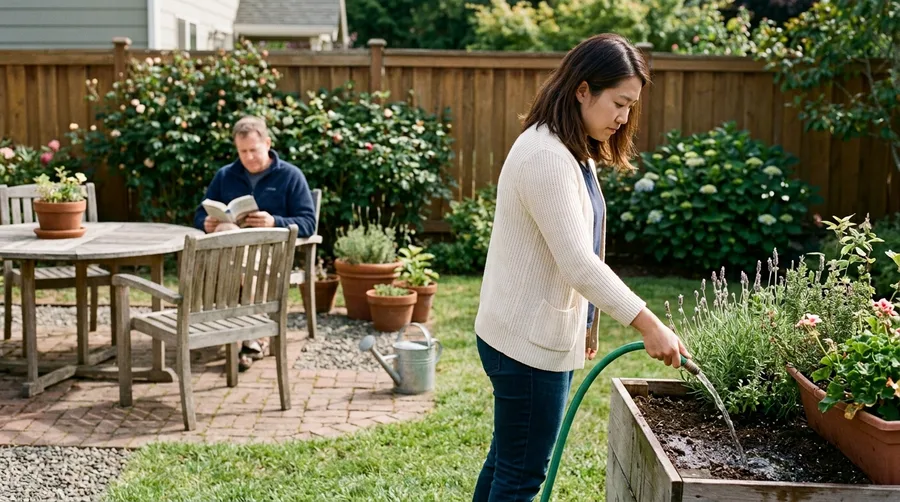
The quiet costs you more than your peace when it hardens into an invisible wall that separates you from the rest of the street. Silence feels like a earned reward after forty years of alarms until the afternoon stretches so thin that every minor creak in the floorboards sounds like an interruption.
People who treat empty space as a vacuum to be feared usually end up turning the television on just to have a voice in the room. Treat the quiet not as an absence of life, but as an acoustic canvas that finally lets you hear your own thoughts without competing against the noise of a commute.
Deliberately choose thirty minutes of complete stillness at ten in the morning, then intentionally break it by playing a record or stepping out onto the porch to water the plants.
⚠️ COMMON MISTAKE
Mistaking Isolation for Solitude
Sitting alone in silence for days is not peaceful rest; it is a slow withdrawal from community life.
6. The Evolution of Social Circles

Work friendships often fade into holiday card acquaintances once office ties are cut and daily proximity disappears.
Researchers who study adult socialization find that informal networks predictably contract by roughly a third during major life transitions unless people intentionally establish new anchor points.
Social networks shrink unless you actively invest in neighborhood groups, local classes, or community volunteering to replace the automatic camaraderie of a shared workplace.
Building new friendships requires the same deliberate effort you put into your career twenty years ago, moving past casual waves to set up recurring weekly touchpoints.
Decide on one consistent weekly group activity, show up at the exact same time for a month, and let familiarity build the foundation naturally.
🤝 Building New Social Connections
Audit Current Ties
List the three people outside family you genuinely want to see more often.
Pick One Venue
Choose a weekly recurring local class or volunteer shift.
Show Up Early
Arrive ten minutes before start time to have casual conversations.
Extend Invitation
Ask someone to grab coffee after the session ends.
7. Finding the Right Words for Change

You stare at your coffee cup across the kitchen island while the television drones on in the background, unable to explain why a quiet Tuesday feels heavier than it should.
When your partner notices the sudden distance and asks what is wrong, avoid vague complaints about feeling restless. Try saying: I miss having a project that takes me out of the house for a few hours. Let us carve out independent mornings this week.
Retirement Needs Pyramid
From basic structure to deep fulfillment
8. The Illusion of Permanent Leisure

I spent the first month of not working assuming that sleeping in until nine o'clock and reading novels on the porch was the entire destination. It turns out that total lack of friction is actually an invisible heavy weight.
What looks like freedom from the outside often feels like aimlessness from the inside once the novelty wears off completely. You thought you wanted endless relaxation, but absolute rest quickly turns into stagnation when nothing requires your attention.
The misread is believing that removing all demands creates peace, when it actually removes the anchors that make a Tuesday evening feel earned. When every day is completely open, no single moment holds any distinct shape or weight.
The fix is building one small, non-negotiable obligation into every single morning that you cannot delegate or cancel. Pick a task that requires your actual hands and leaves a visible trace when it is done.
9. Why Chasing Total Comfort Backfires

You sit down on the patio at two in the afternoon with nothing to do, nothing scheduled, and zero emails waiting, expecting that absolute ease will finally feel like winning. Instead, a dull, restless fog settles in by three o'clock because your mind actually needs friction to stay upright.
The popular line tells you to strip every obligation away until your days are completely frictionless. Follow that advice to its logical end, and you remove the exact type of mental resistance that keeps you sharp.
Introduce one modest, non-negotiable friction point back into your Tuesday, like learning a difficult recipe from scratch or fixing that creaky garden gate yourself, and watch how quickly the hollow feeling lifts.
10. Mastering the Art of the Unplanned Afternoon

We spent the first two years of retirement treating open hours like empty real estate that needed immediate development.
An empty afternoon can feel terrifying when you have spent decades optimizing every hour for maximum productivity and measurable output.
You do not need to fill every minute with chores, hobbies, or errands just to justify your existence on a Tuesday.
Sometimes the best move is to sit on the back porch with a book and let the clock tick without tracking it.
Learning to inhabit unstructured time without guilt is the hidden mastery test of this specific season.
Practice doing absolutely nothing for twenty minutes today and notice how your breathing finally settles down.
11. Navigating Unsolicited Advice from Family

You should really look into that community center group, they have watercolor classes every Tuesday.
Your adult children worry about you slowing down and start offering unsolicited suggestions for your daily routine, transforming a casual kitchen conversation into an evaluation of your independence.
You sit across the kitchen island while your daughter explains how you should join a travel club, watching the digital brochure slide across the granite counter while the morning coffee cools untouched.
That well-meaning advice can feel like an insinuation that you cannot manage your own calendar, turning a simple scheduling suggestion into a subtle questioning of your capability.
Instead of defending your current pace or listing the projects you already have lined up, keep the response remarkably brief by saying you will take a look at their idea later this week, and then pivot the conversation back to their own week without missing a beat.
12. Setting Boundaries with Adult Children

Try saying: I appreciate you looking out for me, but my schedule is mine to manage right now.
Let us talk about something else over dinner.
13. When Restlessness is Actually a Healthy Signal

Feeling restless in your third year is not a failure of your retirement plan; it is a sign that your mind is hungry for fresh input.
Most people panic when the familiar routine stops working, assuming they made a mistake by stepping away from a lifelong career too soon.
When you find yourself pacing the kitchen or rearranging the garage for the third time in a month, that urge to move is often healthy cognitive momentum seeking a new problem to solve.
Instead of trying to suppress the itch or forcing yourself to relax harder, pick up one concrete project that demands actual problem solving, like learning a complex instrument or restoring a mechanical clock.
14. Building a New Framework for Purpose

People tell you that retirement is simply a well-earned vacation that never ends, as if decades of professional drive can be satisfied by endless golf and casual reading.
That advice ignores how human motivation actually operates when the external milestones disappear.
You built your first life around career targets and raising children because those structures were handed to you ready-made.
Your second life requires an entirely different architecture built on personal curiosity, small daily pleasures, and quiet autonomy.
The third year is where you finally stop mourning the old structure and start building the new one on your own terms.
Do not wait for someone else to hand you a new job description or a fresh calendar.
Grab a blank notebook tonight and sketch out three things you want to learn just for the fun of it.
15. The Quiet Triumph of Settling In

Peace is not a permanent vacation; it is the quiet confidence that you can handle the stillness.
Frequently Asked Questions
Why does the third year of retirement feel harder than the first?
The initial novelty of freedom and travel wears off by year three, revealing the quiet reality of unstructured days and shifting domestic routines. This natural transition requires building a new psychological framework rather than just enjoying endless leisure.
How can I handle spending too much time with my partner?
Establish clear physical boundaries and maintain independent hobbies outside the house. Having separate mornings or solo errands keeps the relationship breathable and gives you both something fresh to talk about over dinner.
What should I do if I feel invisible after leaving my career?
Shift your focus from measuring your worth through professional output to cultivating personal curiosity. Volunteer, take up a hands-on craft, or join a local class to build new circles of connection.
Is it normal to feel restless after years of wanting to retire?
Restlessness in retirement is extremely common and usually signals that your mind is hungry for fresh input and productive friction. Channel that energy into learning a challenging new skill rather than seeking absolute comfort.
What Changes First
Notice how your shoulders drop when you stop trying to fill every hour with artificial urgency.
Start with one small routine anchor tomorrow morning, and let the rest of the week unfold with quiet grace.

Meet Edward Green, the founder of GolfingGoal and a seasoned expert in golf. With years of experience on the course and a passion for the sport, Edward has a wealth of knowledge to share. As our Lead Writer, he contributes articles, tutorials, and resources to help readers to improve their skills and reach their full potential on the golf course. Join Our Team!