

You check the tone of a simple text message three times before hitting send.
When someone shifts their posture or goes quiet in the middle of a conversation, your chest tightens instantly.
People who grew up managing a volatile home often carry those exact radar systems into adult relationships without realizing it.
Quick Tips Before You Start
Notice the Radar
Spot when you are scanning a room for subtle mood changes.
Pause the Script
Catch yourself over-explaining before the other person even asks.
Write It Down
Track your physical tension during minor social misunderstandings.
1. Over-Explaining Simple Choices

You cancel a casual dinner plan because you are simply too tired to drive across town, and instead of sending a clean decline, you type out a three-paragraph explanation detailing your work hours, your sleep debt, and traffic patterns.
The other person reads it, says 'No worries at all,' and leaves you wondering why you felt compelled to build a legal defense for resting.
Try replacing the justification with a plain sentence like 'I am too wiped out to make the drive tonight, but let us catch up next week.' Send those exact words, then put the phone down and let the silence sit without adding a single qualifying sentence after it.
💡 Tip: Send the flat sentence, close the chat app, and let the silence sit.
💡 PRO TIP
Keep the Reason Simple
When you offer too many details, you accidentally signal that your time requires someone else's approval to be valid.
2. Scanning Rooms for Micro-Expressions

I used to think my ability to read a room the second I crossed the threshold was just an impressive streak of intuition.
You walk into a familiar kitchen and instantly clock the slight tilt of a shoulder or the exact speed of someone's footsteps.
That hyper-vigilance was once a survival tool used to gauge whether it was safe to ask for help or better to stay invisible, long before those instincts were ever needed for a casual Tuesday night dinner.
Today, it looks like reading catastrophic meanings into a neutral sigh from a coworker who is simply tired from staring at a spreadsheet all afternoon.
When your nervous system treats every minor shift in posture as a weather report, you are spending energy on a storm that isn't happening, leaving nothing left for the actual room you are standing in.
The fix isn't trying to care less about the people around you.
Instead, name the feeling out loud to yourself before acting on it, saying quietly that a heavy sigh is just a heavy sigh, and then let the silence sit until proven otherwise.
3. Apologizing for Taking Up Space

You step slightly to the side in a narrow grocery aisle and immediately mutter an apology to an empty shelf.
The standard advice in self-help spaces tells you to stand your ground and claim your space without shrinking. That obvious advice is wrong here because it ignores what your early environment taught your nervous system. Growing up around unpredictable reactions meant that existing loudly drew friction, so keeping a low profile became a survival strategy rather than a simple lack of confidence.
Instead of forcing artificial bravado that feels risky and foreign, notice the exact physical moment your shoulders rise toward your ears, and consciously drop them three inches down. Let that quiet physical adjustment be the entire exercise for the day.
Physical Tension Signals — At a Glance
🦴 Shoulders
Elevated toward ears
🫁 Breathing
Shallow and rapid
✋ Grip
Tightly clenched hands
Quick Reset
Drop your jaw and exhale slowly to break the physical loop.
4. Waiting for the Other Shoe to Drop

Everything is fine right now, so something must be wrong.
A peaceful Sunday afternoon stretches ahead with zero obligations, zero conflict, and complete quiet.
Rather than resting, your nervous system interprets the absolute calm as a suspicious prelude to a sudden crisis, treating peace as an unsafe condition.
You find yourself inventing tasks or searching for hidden problems just to restore a familiar sense of high-alert busyness that feels more honest than rest.
That quiet ache is simply the cost of growing up where stability was always temporary and the next storm arrived without warning.
Over months and years, this constant bracing quietly drains your emotional reserves, leaving you exhausted by minor inconveniences while major challenges pass you by.
The antidote is deliberately staying in the quiet room for five full minutes without trying to fix anything or brace for impact, letting the silence exist without a threat attached.
⚠️ COMMON MISTAKE
Manufacturing Chaos
Do not mistake your internal anxiety for intuition. When everything is calm, your brain often tries to recreate storms just to feel in control.
5. Assuming Neutral Silence Equals Anger
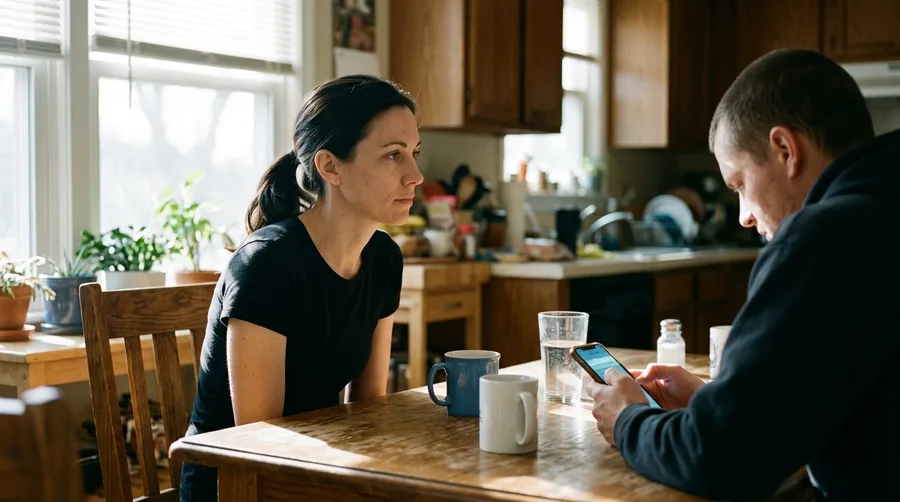
Three seconds of quiet across a kitchen table can turn into an entire internal audit before you even realize you are doing it.
Your partner answers a question with a single, flat word while looking down at their phone, and you immediately translate that neutral pause into personal rejection, quietly reviewing every interaction from the past forty-eight hours.
You think that reading the room with this level of hyper-vigilance means you are deeply attuned to shifts in the emotional climate, but the people who study how early environments shape adult perception find something entirely different going on.
That automatic translation treats an ordinary moment of distraction as an active threat because an earlier version of you learned that quiet periods preceded sudden shifts in safety.
The gap between what is actually happening and what your history tells you is happening creates an imaginary emergency, forcing you to solve a tension that only exists in your own head.
When you notice that immediate internal sprint toward worst-case assumptions, the practical move is to stop and name the physical reality out loud to yourself before you ask a follow-up question.
A neutral pause is rarely an indictment; most of the time, people are simply tired.
— What relational observers keep noting
6. Difficulty Asking Direct Questions

Why is it so difficult to ask a simple question when the answer actually matters to you?
Therapists who study family dynamics consistently find that indirect communication is a learned survival strategy rather than a personality quirk.
When clear questions once triggered unpredictable storms or silent punishments, the nervous system learned to gather data through subtle surveillance instead.
You scan the text for tone shifts while your actual question remains unasked.
Try replacing the circular hints with a plain, direct inquiry: Are we good for tonight?
Frequently Asked Questions
Why do these behaviors show up so late in life?
These coping mechanisms often run quietly in the background until adult relationships demand a level of emotional safety that triggers old survival patterns.
Are these habits permanent?
They are learned relational reflexes, not fixed traits. With steady awareness and small daily adjustments, your nervous system learns new baselines.
How can I stop over-explaining myself?
Practice giving a clean, simple answer without adding justifications, and let the resulting silence sit comfortably without rushing to fill it.
What is the first step toward building inner stability?
Notice when your body goes on high alert during neutral moments, and consciously drop your shoulders while taking a slow, grounding breath.
Your Next Step
Pick just one small reflex to observe this week, whether it is shortening a text message or dropping your shoulders during a quiet moment.
Awareness alone starts to untangle the old wiring, giving you room to choose how you want to show up right now.

Meet Edward Green, the founder of GolfingGoal and a seasoned expert in golf. With years of experience on the course and a passion for the sport, Edward has a wealth of knowledge to share. As our Lead Writer, he contributes articles, tutorials, and resources to help readers to improve their skills and reach their full potential on the golf course. Join Our Team!