
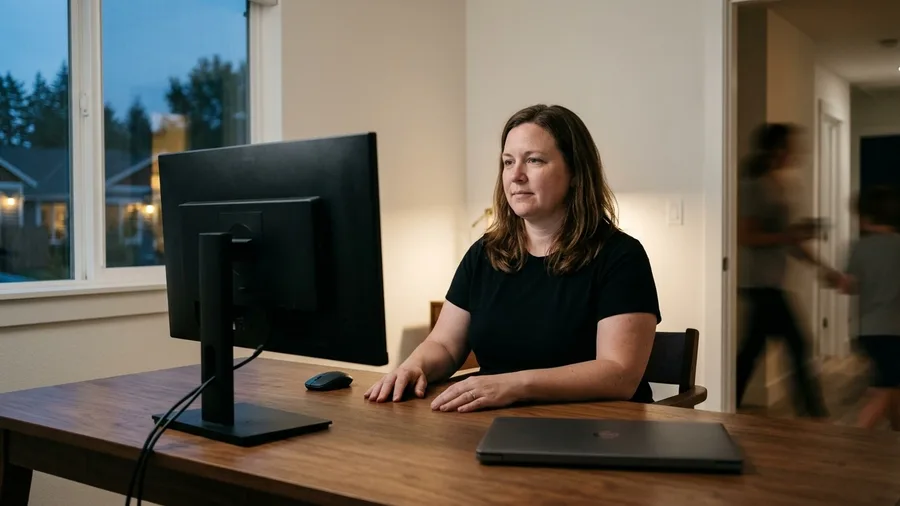
Zero items that trigger background task-switching sit on the wood of a truly focused workspace.
When your field of vision remains free of stray triggers, your attention stops fracturing every ninety seconds.
This short guide covers what to clear off today and why those objects drain cognitive stamina faster than you realize.
Quick Tips Before You Start
Clear the Surface
Remove every object that does not serve the task happening right now.
Silence All Pings
Put phones in another room or inside a closed drawer out of arm's reach.
Wipe the Wood
Start fresh with a clean surface every single morning before logging on.
1. The Open Smartphone Face Up

You sit down at nine in the morning, place your phone beside the trackpad, and tell yourself it is there just in case.
Within four minutes, a screen lights up with a preview line about a logistics delay or a group chat debate, and your eyes flick sideways for one second.
That tiny shift breaks the continuity of whatever sentence you were building in your head, because researchers who study human attention find that even the silent presence of a device in your peripheral field consumes mental capacity simply because your brain works to ignore it.
Think of it less as a tool and more as an uninvited guest standing just over your shoulder, waiting for you to blink so it can demand a reaction.
Put the device inside a drawer behind you or leave it in the kitchen entirely, because out of sight keeps the cognitive bandwidth where your actual work lives.
💡 Tip: Turn off all non-human notifications permanently to protect your baseline attention.
💡 PRO TIP
The Out-of-Sight Rule
If a tool demands your attention without your permission, it belongs in another room.
2. Stacks of Unsorted Paperwork

Is your workspace drowning in a mountain of printed invoices, meeting agendas, and notes from three weeks ago? Most people assume physical paper is harmless background texture until they realize every stray bill acts as an open loop in their working memory.
When you see three unfinished tasks staring at you from the corner of the desk, your nervous system registers them as demands. There are rare exceptions when a physical draft requires active line-by-line editing right this hour.
If you are not actively marking up the page, file it away in a cabinet or scan it into a digital folder before noon.
💡 Tip: Process incoming mail immediately over the recycling bin instead of setting it down.
Paper Thresholds and Rules
3. Incomplete Snacks and Empty Mugs

I will wash that mug when I finish this report, you tell yourself at ten o'clock.
By three in the afternoon, three different glasses, a half-empty water bottle, and a wrapper occupy prime real estate around your keyboard, acting as quiet monuments to every snack you forgot you finished.
Look down at your desk right now and ask yourself whether your immediate workspace looks like a functioning command center or an archaeological dig of your morning routine; if you cannot account for why a dry toast crust from two hours ago is still sitting next to your mouse, you are letting physical clutter silently drain your attention.
Clear the plates the moment you finish eating rather than letting them accumulate into a landscape of stalled intentions. Treat your desk like a cockpit where every square inch serves the present mission rather than recording your breakfast history.
⚠️ COMMON MISTAKE
The Accumulation Trap
Leaving dishes at your workstation signals to your brain that upkeep does not matter.
4. Decorative Trinkets and Souvenirs
Three small plastic figurines, a snow globe from a vacation four years ago, and two framed posters crowd your monitor base, turning a workspace into a physical museum of old memories.
That collection quietly steals three square feet of visual breathing room over months of daily work, forcing your visual cortex to continuously process irrelevant fragments of your past instead of the problem in front of you.
Objects that carry emotional nostalgia or random novelty trigger micro-memories every time your eyes wander, slowly draining your cognitive stamina long before the afternoon slump arrives.
Keep the walls clear and the desk surface strictly utilitarian to protect your attention from these slow, invisible leaks.
A clean surface creates the mental silence required to solve complex problems without friction.
5. The Multi-Tool Caddy Overflow

People often tell you to keep your desktop fully stocked for every possible contingency, but drowning your workspace in a sprawling mess of backup supplies actually fractures your attention before you even begin working on the tasks that matter.
You grab the ceramic cup filled with twenty-four pens, three highlighters that ran dry in 2024, a USB drive from an old project, and a tube of hand cream. Someone asks you for a pen, and you spend ten seconds rummaging through a graveyard of office supplies while the conversation stalls out entirely.
You hold onto tools you have not touched since last autumn because of the persistent, quiet fear that you might need that specific purple marker someday to solve an emergency that never arrives.
Interrupt this loop by saying these exact lines to yourself the next time you look at the holder: "If it does not get used this week, it goes in the drawer. A clean desk is not a storage unit for my good intentions."
Dump the cup down to one pen, one pencil, and a single tube of balm.
Clear tools speed up your hands and keep your focus locked on the task at hand rather than the search. When every object on your desk has an active purpose, your environment stops demanding cognitive tax from you every time you reach across the wood.
💡 Tip: Store backup stationery in a deep drawer out of sight.
🌱 GROWING TIP
The Single-Tool Rule
Keep only the implement you need for the active task right in front of your hands.
Frequently Asked Questions
How often should I clear my desk completely?
Perform a complete surface reset at the end of every single workday. Taking three minutes to return everything to its proper home sets up a calm environment for the following morning.
Is it okay to keep a plant on my desk?
A single small plant can work if it sits outside your immediate line of sight. However, if it requires constant maintenance or attracts gnats, move it to a nearby windowsill.
Where should I put items that do not fit in my desk drawers?
Move overflow items to a dedicated storage closet or a filing cabinet in another part of the room. Your desk surface should remain reserved strictly for active work tools.
What is the best lighting setup for deep focus?
Use a single adjustable desk lamp that illuminates your workspace evenly from the side. Avoid harsh overhead glare or glowing decorative LEDs that flicker in your peripheral vision.
The One Desk Habit to Start Today
Clearing the surface is not about aesthetic perfection or keeping up appearances for an online photo.
Start with the smartphone drawer today, and watch how quickly your mental stamina stops leaking into the room.
Clear Your Desk Today
Take three minutes right now to remove every stray item that does not serve your current task.

Meet Edward Green, the founder of GolfingGoal and a seasoned expert in golf. With years of experience on the course and a passion for the sport, Edward has a wealth of knowledge to share. As our Lead Writer, he contributes articles, tutorials, and resources to help readers to improve their skills and reach their full potential on the golf course. Join Our Team!