

Some 70-year-olds outperform 40-year-olds mentally because they actively build cognitive reserve through sustained, uncomfortable mental strain rather than passive repetition.
While most adults expect processing speed to drop predictably with each decade, researchers keep finding a distinct group of older adults who break the pattern entirely. Their brains recall details faster, solve complex problems with less fatigue, and retain new information far better than adults thirty years younger. The difference is not genetics or luck.
It comes down to how they handle daily cognitive friction. If you feel your own focus slipping under middle-age stress, understanding this mental shift changes how you protect your mind.
Cognitive Longevity Profile
Is cognitive decline before age 70 actually inevitable?

Chronological age turns out to be a remarkably poor predictor of how clearly, quickly, or deeply a person actually thinks day to day.
For decades, standard medical assumptions held that processing speed, working memory, and fluid intelligence peak early and decay on a smooth downward slope. Cognitive testing consistently reveals a much wider spread. A forty-year-old managing a chaotic work schedule often experiences severe brain fog, while a seventy-year-old picking up classical guitar displays razor-sharp focus and fast recall.
Psychologists explain this difference through the concept of cognitive reserve.
Cognitive reserve is your brain's capacity to improvise, build alternative neural pathways, and keep operating effectively when primary routes wear down. Think of a busy city traffic grid. If a main bridge closes and the city lacks back roads, traffic grinds to a halt. If engineers built secondary bridges for years, traffic reroutes smoothly without losing speed.
When mental exhaustion sets in, most people react by clinging strictly to comfortable, repetitive tasks. You tell yourself, I am far too drained for anything complex today, so I will stick to what I know best.
That instinct feels safe, but it starves the brain of new connections. You build secondary bridges only when you force your mind to do work it does not already know how to do. Swap an hour of familiar passive routine for twenty minutes with a brand-new, mildly frustrating skill, like reading sheet music or practicing foreign vocabulary.
Factors Shaping Cognitive Reserve
What makes 'Super-Agers' different from the rest of us?

Why do some people manage to retain the sharp memory of a healthy twenty-something well into their seventies, while others notice their executive function and focus slipping away decades earlier?
Neuroscientists studying these super-agers found startling physical evidence in brain scans: their cortex remains noticeably thicker in regions controlling attention and working memory. Crucially, their anterior cingulate cortex — the area governing emotional regulation during hard tasks — stays dense and active. Where most adults misinterpret mental frustration as fatigue and retreat, super-agers treat that friction as the actual training signal.
Efficiency is the enemy of growth.
To build lasting sharpness, you need to reframe how you handle everyday frustration. When you encounter a confusing manual, a steep learning curve at work, or a complex problem that makes you want to close the tab, stay with it. Leaning directly into that mental strain is what keeps those critical brain structures intact.
Cognitive Patterns: Drift vs. Growth
Active Strain (Super-Agers)
- Tolerates the awkwardness of learning foreign grammar
- Takes up complex hand-eye skills like woodworking or piano
- Views mental frustration as a sign of neural construction
- Seeks out complex, multi-layered social debate
Passive Drift (Early Decline)
- Repeats familiar crosswords and word puzzles daily
- Sticks strictly to established work routines
- Abandons new tasks as soon as they feel clumsy
- Consumes passive media without analytical effort
Why do routine tasks fail to keep your brain young?
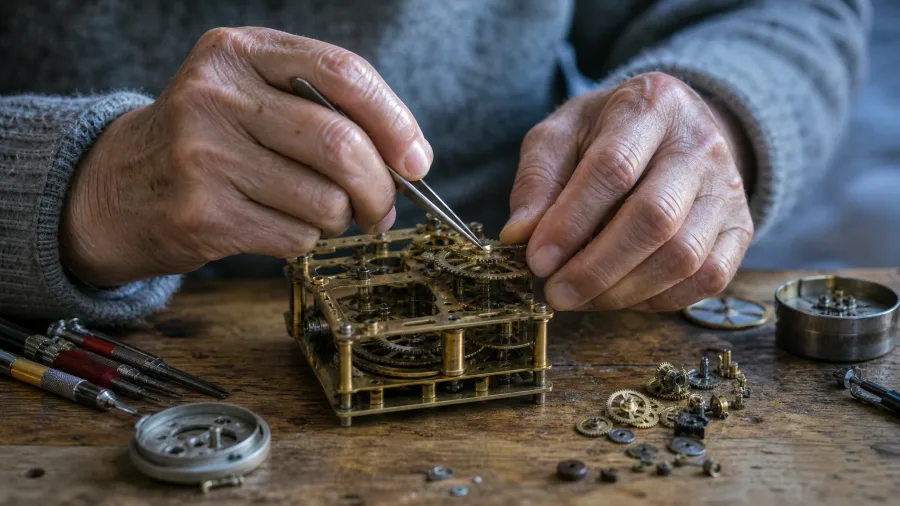
You breeze through your daily puzzle and handle a heavy workload before lunch without pausing once to think. Ask yourself one question: when was the last time a daily task made you feel genuinely clumsy?
If it has been months, your brain is running on autopilot.
Mastering a pattern causes your nervous system to prioritize efficiency, converting familiar tasks into automated loops. Even intense, high-stress work builds zero cognitive reserve if it relies on scripts you built years ago. Without novel friction, synapses shrink. Trade ten minutes of comfortable routines today for an unfamiliar challenge that forces real struggle.
How does emotional stress age a 40-year-old brain faster?

I used to mistake my own mid-afternoon brain fog for early decline.
When a 40-year-old stumbles over a plain word or loses focus mid-sentence, they usually worry their mind is giving out. In reality, the culprit is baseline nervous system exhaustion. Sustained elevated cortisol impairs the hippocampus, making it hard to retrieve stored memories. When attention is fractured across fifty daily alerts, your brain never consolidates information properly.
A 70-year-old often appears sharper simply because their life carries far less background interference. Sleeping eight hours and focusing deeply on one complex project lets their raw processing horsepower operate without constant friction.
Clutter mimics cognitive loss until you remove it.
Before assuming your memory is failing, try silencing your non-essential digital alerts for a full afternoon. Giving your nervous system genuine quiet is often all it takes to restore your baseline mental speed.
⚠️ COMMON MISTAKE
Confusing Overwork with Cognitive Exercise
Answering eighty emails while juggling back-to-back demands is not a mental workout. It is cognitive stress that depletes prefrontal resources without triggering healthy neuroplastic adaptations.
What physical and social habits directly protect executive function?

Most advice suggests that sitting quietly with a word puzzle is the single best way to protect your mental edge. It is not.
Physical movement is the primary biological trigger for cognitive health. Sustained aerobic exercise, like brisk walking, stimulates brain-derived neurotrophic factor – a key protein that supports neuron survival and builds new synaptic connections. Without regular movement, purely intellectual exercises lack the biological foundation required to stick.
Live social interaction changes the math. Decoding vocal tone, body language, and fast conversation in real time directs where that exercise-driven neural growth lands. Swap one solitary puzzle for a walk with a friend today.
The brain does not rebuild its pathways during comfortable recall. It rebuilds when forced to navigate unfamiliar friction.
— What cognitive neuroscientists keep repeating
How can you tell if your daily routines are sharpening or dulling your mind?

"I love my routine because everything in my day just flows on autopilot." It feels satisfying to be efficient, but if you cannot recall feeling genuinely incompetent at a new task in the last six months, your brain is coasting. You are relying entirely on established efficiency patterns rather than building fresh cognitive reserve.
Real mental effort is supposed to feel uncomfortable.
It feels like searching for a word on the tip of your tongue, tripping over the rules of a new card game, or fumbling with unfamiliar guitar chords. That precise feeling of awkward strain is the biological signal telling your brain to construct and reinforce its neural pathways.
If your day feels completely smooth from start to finish, your nervous system is taking a long-term break from growth. You might feel productive, but you are spending existing mental currency rather than earning interest.
Pick one simple task this week that forces you to feel like a beginner for fifteen minutes, and treat that brief frustration as proof your mind is working.
High-Yield Mental Friction Sources
Where should you start if you want to rebuild mental sharpness today?

Frantic weekend overhauls usually yield little more than frustration and burnt-out effort, leaving real cognitive reserve untouched while adding daily stress.
Cognitive researchers repeatedly find that sustained, uncomfortable friction drives far more structural adaptation than brief bursts of intense effort. Rebuilding sharpness starts by selecting one skill combining mental and physical coordination, such as life drawing, basic music theory, or footwork drills, and giving it twenty protected, notification-free minutes each day.
Pairing that session with a daily thirty-minute brisk walk outdoors promotes circulation and growth factors that rebuild working memory within weeks. Consistency quietly outperforms occasional intensity every time.
💡 PRO TIP
The 20-Minute Frustration Protocol
Set a timer for twenty minutes. Work on a skill where you make mistakes every few seconds. When your brain feels warm and tired, stop. That specific sensation is the physical marker of cognitive reserve being built.
Frequently Asked Questions
Can a 40-year-old really have worse cognitive function than a 70-year-old?
Yes. Chronic stress, sleep deprivation, and relentless multitasking can severely depress attention, working memory, and executive function in a 40-year-old. Meanwhile, a healthy 70-year-old with rich cognitive reserve and low stress can show significantly better performance on complex cognitive tasks.
Do commercial brain-training apps actually build cognitive reserve?
Most digital brain games improve your score on those specific games, but show minimal transfer to real-world tasks. Real skills like learning an instrument, mastering a complex craft, or speaking a foreign language engage far broader neural networks and offer greater long-term benefits.
How many hours a week do I need to spend on complex tasks to see results?
Short, daily sessions of 20 to 30 minutes are far more effective than long weekend blocks. Consistency triggers synaptic adaptations, whereas sporadic efforts produce less neural growth.
Is physical exercise really necessary for cognitive sharpness?
Yes. Aerobic exercise stimulates the release of BDNF, a key protein that promotes neuroplasticity and protects existing neurons. Without physical movement, building cognitive reserve is significantly harder.
What is the single best activity for keeping an aging brain sharp?
There is no single best activity. The best option is whatever skill currently feels most unfamiliar and challenging to you, whether that is learning to read sheet music, mastering a new language, or playing strategy games.
The First Move for a Sharper Mind
If I were noticing mental fog or mid-afternoon focus drops today, I would not download another brain game app or add more items to my daily checklist. I would pick up a second-hand acoustic guitar or a beginner foreign language workbook tonight.
I would spend twenty minutes struggling through the basics, accept the clumsy feeling as proof of neural growth, and follow it with a quick brisk walk around the block. That simple combination is where lasting mental sharpness begins.
Test Your Daily Cognitive Friction Today
Review your weekly routines and identify one automated habit you can swap for a new, challenging skill starting this week.

Meet Edward Green, the founder of GolfingGoal and a seasoned expert in golf. With years of experience on the course and a passion for the sport, Edward has a wealth of knowledge to share. As our Lead Writer, he contributes articles, tutorials, and resources to help readers to improve their skills and reach their full potential on the golf course. Join Our Team!