

You reach 3 AM, staring at the ceiling, wondering why your eyes snap open wide while the rest of the house sleeps. Dismissing chronic sleep fragmentation as an inevitable consequence of aging leaves you exhausted every single morning.
While baseline circadian rhythms shift naturally as we get older, cumulative environmental friction in the bedroom often drives those persistent midnight arousals.
Modifying your immediate sleeping habitat compensates for declining physiological reserves, and you can take control of your nights starting tonight.
The Biology of Aging Sleep: Temperature, Light, and Melatonin

Core body temperature regulation changes significantly with age.
Older adults require a cooler ambient environment to trigger the natural nighttime drop necessary for deep sleep.
The flattening of the circadian amplitude means the biological signal between day and night becomes less pronounced, making light pollution much more disruptive than it used to be.
Sleep Architecture Shifts After 60
Key biological metrics every older adult should know
Change 1: Lowering Ambient Bedroom Temperature to Match Core Shifts
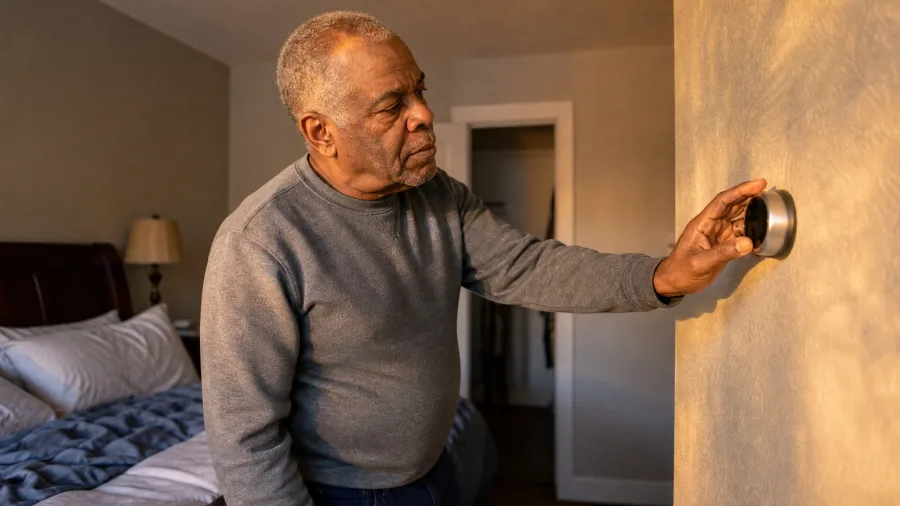
Set your bedroom thermostat between 60°F and 67°F specifically.
Trapped body heat under heavy covers triggers subconscious micro-awakenings because your skin cannot offload warmth efficiently when room temperatures stay too high.
Make actionable adjustments tonight by timing your window ventilation, setting programmable HVAC schedules, and evaluating current radiator or vent placement relative to the bed.
⚠️ COMMON MISTAKE
Overheating Your Sleeping Space
Many adults over 60 keep their homes too warm for comfort during winter months, which directly sabotages core body temperature drops required for uninterrupted rest.
Change 2: Upgrading to Phase-Change and Breathable Bedding Materials

Synthetic polyester blends trap heat and create localized hot spots that disrupt your rest.
Switch immediately to natural, highly breathable fibers like long-staple cotton, French linen, or bamboo-viscose to allow continuous airflow through the night.
Moisture-wicking properties in these fabrics prevent night sweats associated with vasomotor shifts, keeping your micro-climate dry and comfortable from dusk until dawn.
Bedding Materials: Synthetic vs. Natural Fibers
Synthetic Blends
- Traps body heat rapidly
- Retains moisture against skin
- Increases midnight awakenings
- Lacks natural breathability
Linen & Percale Cotton
- Promotes airflow and cooling
- Wicks away moisture instantly
- Softens with every wash
- Supports stable thermal regulation
Change 3: Eliminating Nighttime Light Pollution and Blue-Light Leakage

Aging lenses in the eyes suffer from corneal yellowing, which paradoxically increases sensitivity to short-wavelength blue light.
Identify hidden bedroom light sources like charging indicator LEDs, digital alarm clock displays, and street light infiltration through thin blinds.
Install blackout cellular shades, cover appliance indicator lights with opaque stickers, and replace bedside bulbs with warm-spectrum options under 2700K.
Hidden Sources of Bedroom Light
Change 4: Sound Masking and Acoustic Mitigation for Fragmented Sleep

Your auditory cortex remains hyper-vigilant during sleep.
Age-related changes in sleep architecture make environmental noise spikes far more likely to cause full awakenings from deep rest stages.
Introduce non-looping pink or brown noise machines, install heavy solid-core doors, and use acoustic weatherstripping on door frames to block out erratic household sounds.
💡 PRO TIP
Choose Pink Noise Over White
Pink noise features deeper frequencies that mimic natural rainfall, which studies show helps older adults maintain stable slow-wave sleep patterns despite outside disturbances.
Change 5: Optimizing Mattress Support and Spinal Alignment for Joint Comfort
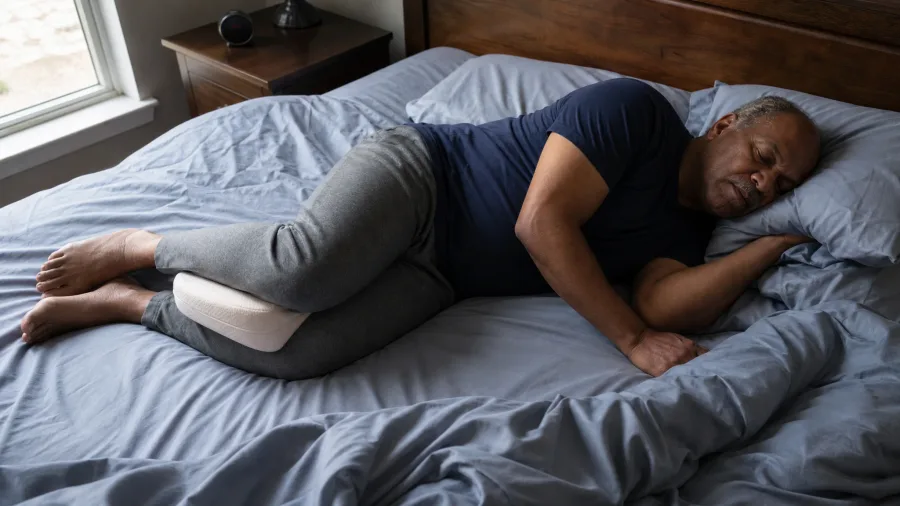
Chronic hip and lower back stiffness in the morning stems directly from pressure points created by sagging mattresses.
Proper spinal alignment reduces the subconscious tossing and turning driven by localized joint discomfort and restricted circulation.
Test your mattress support integrity, utilize knee or lumbar pillow placement to neutralize pelvic tilt, and rotate your mattress every six months.
Best Joint Relief Props
Change 6: Curating a Calming Sensory Palette (Scent and Tactile Flow)
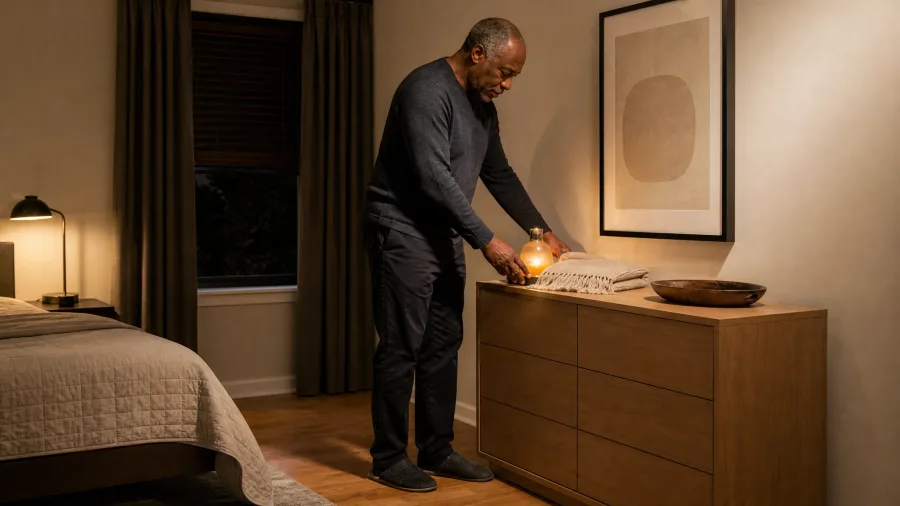
The olfactory bulb links directly to your limbic system.
Targeted scents like lavender or cedarwood down-regulate sympathetic nervous system activity and prepare your body for rest.
Decluttering visual noise is equally vital because an untidy sleeping environment subconsciously signals stress to the brain before sleep onset.
Budget Breakdown for Bedroom Optimization
Change 7: Establishing a Pre-Sleep Environmental Wind-Down Routine

Synchronize your environmental changes with consistent behavioral cues every single evening.
Dim your bedroom lights sixty minutes before bed to signal natural melatonin synthesis without relying on supplements.
Establish a consistent bedroom entry ritual that physically separates daytime stressors from your sleep sanctuary and lowers your heart rate.
🌙 The 60-Minute Pre-Sleep Environmental Routine
Drop Temperature
Lower the programmable thermostat to 65°F to signal your body for cooling.
Dim All Lights
Switch off overhead fixtures and rely solely on amber bedside lamps.
Engage Sound Masking
Turn on your pink or brown noise machine to mask outside disturbances.
Enter Sanctuary
Step into your decluttered bedroom free of work materials and screens.
Environmental Disruption Spectrum
Ranking what wakes you up most frequently after 60
- Thermal Discomfort: Excess room heat and heavy blankets trigger the most subconscious waking episodes.
- Light Intrusion: Streetlights and indoor LEDs suppress melatonin production significantly.
- Acoustic Spikes: Sudden sharp noises pull you out of deep slow-wave sleep stages.
- Joint Pressure: Improper mattress support creates aches that cause restless shifting.
Self-Audit: Which Bedroom Bottleneck Is Disrupting Your Nights?

Diagnose your specific nightly disruptions using a structured symptom review.
If you wake up sweating, temperature control is your primary bottleneck that requires immediate attention.
Change one variable at a time over a fourteen-day window to accurately measure its impact on your overall sleep continuity.
Priority Implementation Order
Your Sanctuary Redefined
Reclaiming restorative sleep after 60 is an environmental design challenge, not an inevitable medical defeat.
Start with a single high-impact adjustment tonight, such as lowering your thermostat or eliminating stray indicator lights, and enjoy your mornings again.

Meet Edward Green, the founder of GolfingGoal and a seasoned expert in golf. With years of experience on the course and a passion for the sport, Edward has a wealth of knowledge to share. As our Lead Writer, he contributes articles, tutorials, and resources to help readers to improve their skills and reach their full potential on the golf course. Join Our Team!