
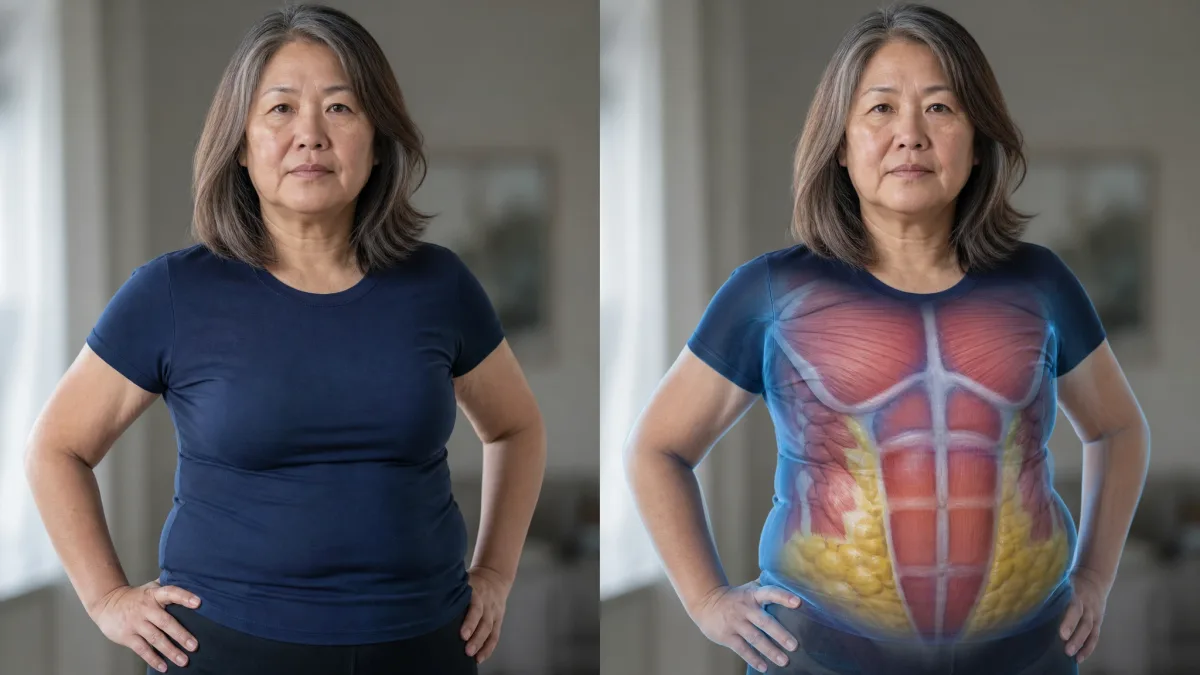
You step on the bathroom scale, see a number that matches your college jeans, and feel a momentary wave of relief.
Then you catch your reflection in the mirror under harsh lighting, and the relief vanishes entirely.
Your arms feel soft, your midsection carries a stubborn layer of padding, and your stamina on the stairs leaves you breathless.
This is normal-weight central obesity, better known as the skinny-fat trap.
Traditional weight-loss advice tells you to eat less and run more, but that exact prescription makes the problem worse by devouring your lean muscle mass.
By the end of this article, you will know exactly why standard diets fail this body type and how to build the muscle that transforms your metabolism.
⚠️ COMMON MISTAKE
The Scale Lies: Why BMI Fails You
Relying strictly on your bathroom scale hides the dangerous loss of skeletal muscle tissue while visceral fat quietly accumulates around your organs.
The Mechanism: What Is Skinny Fat Beneath the Skin?

Your bathroom scale measures total mass, not the ratio of muscle to adipose tissue.
When you look slender in clothes but soft in the mirror, your body composition is tilted toward low lean mass and high visceral or ectopic fat.
Visceral fat wraps around your internal organs, driving up systemic inflammation and insulin resistance.
Meanwhile, your skeletal muscle tissue gets infiltrated by tiny droplets of ectopic fat.
This combination wrecks your basal metabolic rate.
Muscle is metabolically active tissue that burns calories even at rest.
When muscle mass drops, your daily energy expenditure plummets right along with it.
Chronic high carbohydrate intake paired with a sedentary routine promotes this exact fat-to-muscle ratio, even if your overall weight stays flat for decades.
Shattering the Skinny-Fat Misconceptions
Myth Versus Reality: Why Traditional Diets Make It Worse

Severe caloric restriction without resistance training is a disaster for skinny-fat bodies.
When you slash calories and rely only on cardio, your body burns through lean muscle tissue before touching stubborn adipose stores.
You end up lighter on the scale, but softer, weaker, and metabolically slower than when you started.
Spot reduction is another costly myth.
Doing hundreds of daily crunches strengthens your abdominal wall, but it cannot selectively melt the fat resting directly on top of those muscles.
True body recomposition requires shifting your entire physiological priority away from starvation and toward muscle retention.
The Trap Versus The Fix
The Skinny-Fat Trap
- Severe calorie deficits below 1,200 calories
- Endless daily steady-state cardio
- Zero heavy resistance training
- Low protein intake spread unevenly
- Chronic scale obsession
The Recomposition Fix
- Maintenance calories or a mild deficit
- Progressive overload lifting 3 to 4 times weekly
- High protein target of 1.6 to 2.2g per kg
- Daily step baseline of 8,000+ steps
- Focus on tape measurements and strength
Pillar One: Progressive Overload and the Muscle-Centric Shift
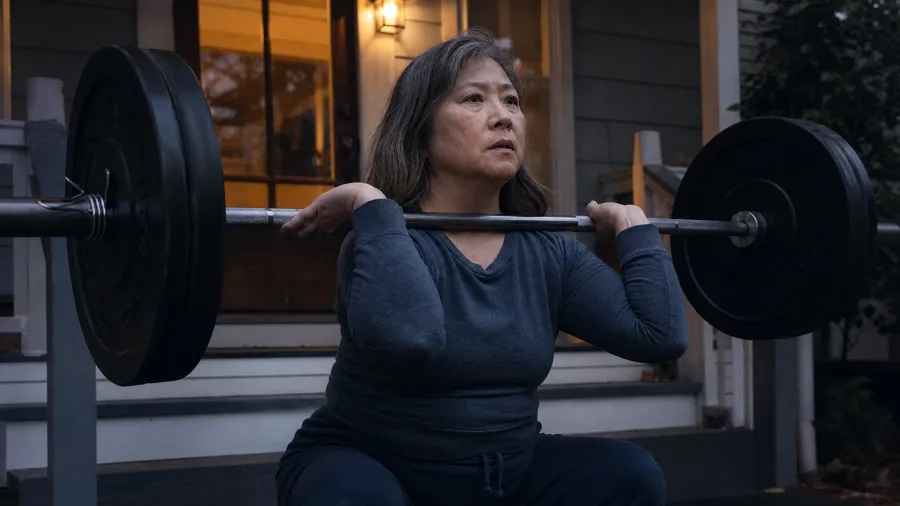
Skeletal muscle acts as your body's primary glucose sink and metabolic engine.
Building that muscle is the single most effective lever for fixing skinny-fat syndrome.
This requires progressive overload, which means systematically demanding more from your muscles over time.
Forget light weights for high reps.
Focus on compound movements like barbell squats, deadlifts, overhead presses, and bent-over rows.
Commit to 3 to 4 full-body resistance sessions per week, resting a full 48 hours between working the same muscle groups.
If you do not challenge your muscle fibers with heavy resistance, your body has zero physiological reason to retain or build lean tissue.
🏋️♂️ The 4-Day Progressive Overload Split
Day 1: Lower Body Power
Focus on heavy barbell squats and Romanian deadlifts for mechanical tension.
Day 2: Upper Body Push
Perform overhead press and weighted pushups to stimulate chest and shoulders.
Day 3: Rest and Recovery
Prioritize light walking and deep sleep to allow muscle protein synthesis.
Day 4: Full Body Compound
Execute barbell rows, Bulgarian split squats, and lat pulldowns with strict form.
The Muscle-Building Sequence
Pillar Two: Protein, Thermogenesis, and Nutrient Partitioning

You cannot build new muscle tissue out of thin air.
Target 1.6 to 2.2 grams of high-quality protein per kilogram of body weight daily to drive body recomposition.
Higher protein intake creates a powerful metabolic advantage through the thermic effect of food.
Your body burns roughly 20 to 30 percent of the calories contained in protein just digesting and processing it.
Prioritize whole-food sources like wild-caught salmon, whole eggs, Greek yogurt, chicken breast, and lentils.
Nutrient partitioning dictates where your calories go.
When you combine heavy lifting with high protein intake, incoming nutrients preferentially fuel muscle repair rather than fat storage.
High-Bioavailability Protein Sources — At a Glance
🐟 Wild Salmon
22g protein per 100g
🥚 Whole Eggs
6g protein per large egg
🥣 Greek Yogurt
17g protein per 170g serving
🍗 Chicken Breast
31g protein per 100g cooked
Daily Target
Aim for 25 to 40 grams of protein in each of your main daily meals.
💡 PRO TIP
Even Out Your Protein Distribution
Do not cram 100 grams of protein into dinner. Split your intake across four equal meals to maximize muscle protein synthesis throughout the day.
Pillar Three: Managing Cortisol, Sleep, and Daily Movement

Chronic psychological stress and sleep deprivation wreck body composition by elevating cortisol levels.
High cortisol encourages visceral fat storage while actively breaking down fragile muscle tissue.
Aim for seven to eight hours of uninterrupted sleep every single night to regulate these hormones.
Do not overlook Non-Exercise Activity Thermogenesis, known as NEAT.
Fidgeting, standing, cleaning, and walking account for a massive share of your daily energy expenditure.
Aim for 8,000 to 10,000 daily steps instead of grinding through exhausting HIIT cardio sessions that spike cortisol and burn muscle.
Daily Recovery Essentials
Activity Traffic Light for Skinny-Fat Recomposition
- 🟢 Heavy Resistance Training — Lifting heavy weights 3 to 4 times weekly builds muscle and boosts metabolism.
- 🟢 Brisk Daily Walking — Accumulating 10,000 daily steps burns fat without elevating cortisol.
- 🟡 Moderate Steady Jogging — Keep distance running minimal so it does not interfere with muscle recovery.
- 🔴 Daily Extreme HIIT — High-intensity burnout workouts elevate cortisol and destroy lean tissue.
The Medical Consensus: Why Recomposition Outperforms Starvation

Endocrinology and sports science research converge on a very clear physiological reality.
Improving skeletal muscle mass directly enhances cellular glucose uptake and lowers circulating insulin levels.
Clinical trials confirm that simultaneous muscle gain and fat loss, known as body recomposition, is fully achievable in untrained and skinny-fat individuals.
You do not need extreme bulking and cutting cycles to reshape your physique.
Consistency in heavy resistance training, adequate dietary protein, and stress management outperforms every quick-fix supplement on the market.
Self-Check Protocol: Are You Actually Skinny Fat?

Evaluate your starting point using objective metrics rather than emotional mirror checks.
First, calculate your Body Mass Index to confirm you sit within the normal healthy range.
Next, measure your waist-to-hip ratio; a high ratio combined with normal BMI points squarely to visceral fat accumulation.
Test your strength benchmarks by checking if you can perform basic bodyweight movements with pristine form.
Toss your bathroom scale into the closet and rely on weekly tape measurements around your waist, progress photos in identical lighting, and how your tailored clothing fits.
Visible body recomposition typically takes 8 to 12 weeks of strict adherence.
The Recomposition Timeline
The 4 Audit Metrics That Matter
Frequently Asked Questions
Should I bulk or cut if I am skinny fat?
Neither approach works well on its own. Focus strictly on body recomposition by eating at maintenance calories or a very mild deficit while lifting heavy weights.
How long does it take to fix skinny fat?
Visible changes typically emerge in 12 to 16 weeks with strict adherence to progressive resistance training, adequate protein targets, and consistent sleep hygiene.
Do I need cardio, or should I stop entirely?
Keep low-intensity steady-state cardio like brisk daily walking for overall health and NEAT, but drop excessive high-intensity distance running that burns muscle.
Can older adults reverse skinny fat and sarcopenia?
Yes, muscle protein synthesis responds to progressive resistance training and adequate dietary protein across all adult age groups without exception.
Are fat burners or supplements necessary?
No commercial supplement plays a meaningful role compared to proper sleep, heavy progressive overload, and whole-food protein intake.
🌱 GROWING TIP
Your Week 1 Launchpad Checklist
Lock in 3 heavy lifting sessions, hit your daily protein minimum, and establish an 8,000-step baseline starting today.
Your First Week of Better Body Composition
Stop obsessing over the dwindling number on your bathroom scale and start building the metabolic engine that burns fat naturally.
Commit to heavy compound lifting, prioritize real whole-food protein at every meal, and protect your recovery schedule starting today.

Meet Edward Green, the founder of GolfingGoal and a seasoned expert in golf. With years of experience on the course and a passion for the sport, Edward has a wealth of knowledge to share. As our Lead Writer, he contributes articles, tutorials, and resources to help readers to improve their skills and reach their full potential on the golf course. Join Our Team!