

You step out of bed, land on the rug, and your right knee gives you that familiar, sharp reminder that you are not thirty anymore.
It is frustrating because you walk three miles every single day, carry your own groceries, and take the stairs whenever possible. Yet despite all that effort, rising from a deep living room armchair feels harder this year than it did last spring.
Walking keeps your heart pumping, but it will not save your balance or your quads.
After age 60, age-related muscle loss accelerates rapidly, eating away up to 8% of your total muscle mass per decade if you rely on cardio alone. The secret to reversing that slide is targeted, high-tension resistance that signals your nervous system to keep building tissue.
How Aging Muscles Actually Rebuild: The Science of Mechanical Tension

Your muscles are not broken.
They are simply suffering from anabolic resistance, a biological condition where older tissue requires a significantly stronger stimulus to activate muscle protein synthesis. Gentle light weights or high-rep daily chores simply do not cross that activation threshold anymore.
Mechanical tension is the master key.
When you place a compound load on a muscle and lower it under control, you create microscopic cellular strain. This action signals motor units in your spinal cord to recruit fast-twitch type II fibers, which are the exact fibers responsible for catching your balance during a stumble.
Focus on the lowering phase of every movement.
Spending three controlled seconds lowering yourself into a chair creates three times more muscular stimulation than dropping down quickly and popping back up.
⚠️ COMMON MISTAKE
The Light-Weight Trap
Lifting two-pound pink dumbbells fifty times builds local endurance, not structural muscle mass. To overcome anabolic resistance after 60, choose a weight or body angle where 8 to 10 slow repetitions feel genuinely challenging.
Sarcopenia Progression & Inactivity Spectrum
How muscle loss impacts independence if unaddressed after 60
- Light Walking Only: Maintains cardiovascular health but loses 3–5% quad strength per decade.
- Cardio + Light Dumbbells: Slows endurance decline; fails to trigger fast-twitch fiber retention.
- Progressive Strength Moves: Triggers muscle protein synthesis and actively restores lost density.
Move 1: The Box Squat (Rebuilding Quad Power and Knee Stability)
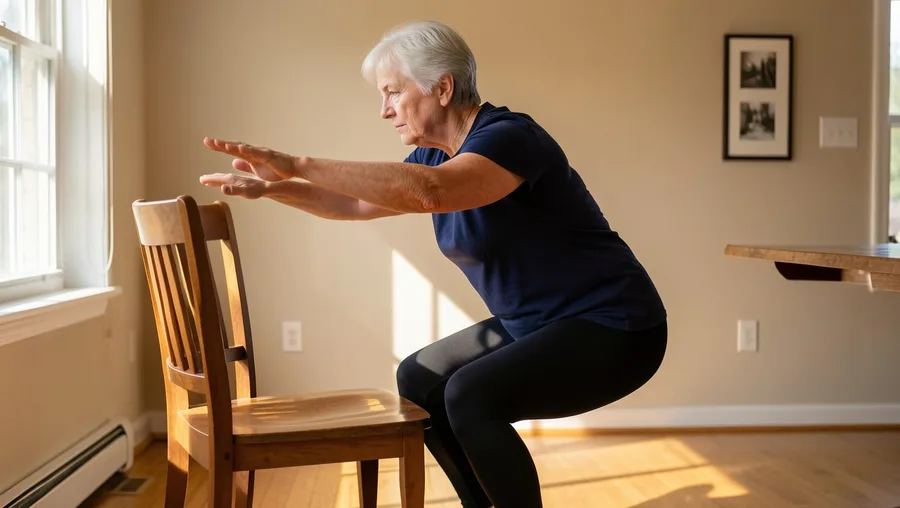
This is the single most crucial movement for staying out of a nursing home.
The box squat directly targets your quadriceps, gluteus maximus, and core stabilizers. It trains the exact motor pattern required to stand up from a low car seat, a couch, or a toilet without needing to push off your knees with your hands.
Set up in front of a sturdy dining chair.
Stand with your feet shoulder-width apart, toes turned outward slightly by ten degrees. Reach your hips backward first, as if searching for a bench behind you, and lower yourself under full control until your thighs lightly touch the seat cushion.
Never dump your body weight onto the chair.
Pause for one second at the bottom while keeping your chest tall, then drive firmly through your mid-foot and heels to return to standing. Aim for two sets of eight controlled repetitions.
Move 1: The Box Squat — At a Glance
🎯 Primary Target
Quadriceps & Glutes
⏱️ Tempo
3 sec down, 1 sec up
🔄 Volume
2–3 sets of 8–10 reps
🪑 Setup
Sturdy chair or bench
Form Priority
Keep your heels glued to the floor and avoid letting your knees collapse inward.
Best For
Move 2: The Romanian Deadlift (Restoring the Posterior Chain and Hips)

Most lower back pain in mature adults starts with weak glutes.
Decades of sitting shorten your hip flexors and cause your posterior chain to shut down. The Romanian Deadlift teaches your hips how to hinge properly, shifting daily lifting loads away from your vulnerable lumbar spine and onto your strongest hamstrings and gluteal muscles.
Stand tall while holding a light dumbbell or water bottle in each hand.
Maintain a very soft bend in your knees throughout the entire movement. Push your tailbone straight back toward the wall behind you while keeping the weights sliding directly along the front of your thighs and shins.
Stop lowering once your torso reaches forty-five degrees.
Squeeze your glutes tightly to pull your hips forward and stand tall again. If your lower back rounds at any point, you have reached past your current hamstring flexibility limit.
We do not stop moving because we grow old; we grow old because we stop loading our bones and joints safely.
— Consensus among physical therapists and senior strength coaches
Move 3: The Incline Push-Up (Upper Body Push and Core Integration)

Standard floor push-ups place excessive strain on aging wrists and shoulders.
By elevating your hands onto a sturdy kitchen counter or heavy bench, you reduce the shear force on your rotator cuff while retaining every bit of muscle-building tension across your chest, triceps, and anterior shoulders.
Place your hands slightly wider than shoulder-width apart on the counter.
Step your feet back until your body forms a straight line from your ears down to your ankles, engaging your abdomen as if holding a full plank. Lower your chest down until it hovers two inches above the counter edge.
Press the counter away firmly to return to the starting plank position.
This move trains your deep core to stabilize your pelvis while pushing heavy doors or lifting overhead items.
📅 How to Build Your 3-Move Weekly Routine
Step 1: Baseline Assessment
Test your box squat depth using a standard 18-inch dining chair without using weights.
Step 2: Establish Frequency
Schedule your sessions on non-consecutive days, such as Tuesday and Friday mornings.
Step 3: Execute Two Sets
Perform 8 controlled repetitions of each movement, resting two full minutes between sets.
Step 4: Progressive Overload
Add a single repetition every fortnight once your current target feels smooth and pain-free.
The Safety Consensus: Recovery, Frequency, and Protein Timing

More is not better when rebuilding tissue after 70.
Your muscles grow and adapt during rest periods, not while you are performing the exercises in your living room. Training two to three non-consecutive days per week gives aging tendon structures adequate time to repair collagen fibers between sessions.
You also need adequate raw materials.
Nutrition researchers consistently recommend that active older adults consume 25 to 30 grams of high-quality protein per meal to trigger muscle protein synthesis effectively. Spreading your protein evenly across breakfast, lunch, and dinner prevents muscle breakdown.
Never lift to complete physical failure.
Always leave two clean repetitions in reserve to protect your joint capsules and avoid central nervous system fatigue.
Training Guidelines: Young Adults vs. 60+ Rebuilding Protocol
Standard Young Adult Advice
- Train 4–6 days per week with high volume
- Push sets to technical failure
- Focus heavily on maximum weight lifted
- Single big protein meal at dinner
60+ Rebuilding Protocol
- Train 2–3 non-consecutive days per week
- Keep 1–2 reps in reserve on every set
- Prioritize movement control and tempo
- Even 25–30g protein doses across all meals
Sample Weekly Rebuilding Schedule
The 4-Week Self-Check: How to Measure Real Progress
Throw away your bathroom scale.
Body weight is a terrible metric for muscle recovery after 70 because you may burn visceral fat while gaining dense, heavy functional muscle tissue simultaneously.
Track functional independence markers instead.
Pay attention to how easily you stand up from low armchairs, how stable your balance feels when stepping off curbs, and how much energy you have at the end of the day.
Strength gains happen in your nervous system during the first month before visible tissue changes appear.
The Late-Life Muscle Priority Pyramid
Build your physical foundation from the bottom up
💡 PRO TIP
Grip Strength Bonus
Hold two heavy water bottles for 30 seconds after completing your Romanian Deadlifts. Grip strength is directly correlated with long-term shoulder stability and overall mortality outcomes in late life.
Your First 10 Minutes: Start Building Muscle Today
Do not wait for next Monday.
Stand up right now, position yourself over your chair, and perform five controlled box squats focusing on driving through your mid-foot.
That single set breaks the cycle of hesitation.
Pick two non-consecutive days this week to execute all three movements, keep your recovery high, and let mechanical tension do the heavy lifting.
Start With This One
If you do only one thing from this guide today, make it the box squat.
Mastering sit-to-stand strength preserves your physical independence faster than any supplement, cardio routine, or gym equipment available.

Meet Edward Green, the founder of GolfingGoal and a seasoned expert in golf. With years of experience on the course and a passion for the sport, Edward has a wealth of knowledge to share. As our Lead Writer, he contributes articles, tutorials, and resources to help readers to improve their skills and reach their full potential on the golf course. Join Our Team!