

You glance at your wrist at 7:00 p.m., see 4,200 steps, and feel a familiar flash of defeat.
For decades, fitness trackers and magazine columns have insisted that 10,000 daily steps is the baseline for healthy living. If you fall short, it feels like you missed the mark entirely. But if you are over 60, that arbitrary target is not just unnecessarily exhausting—it lacks medical foundation.
Your body does not evaluate movement the way it did at 25.
Recent large-scale epidemiological studies tracking tens of thousands of older adults reveal a drastically different reality. The sharpest drop in mortality risk happens far earlier than popular culture suggests. By the time you finish reading this guide, you will know precisely how many steps your body needs to protect your heart, brain, and joints—and why you can safely stop chasing a young adult's metric.
Why the 10,000-Step Goal Was Never Medical Advice
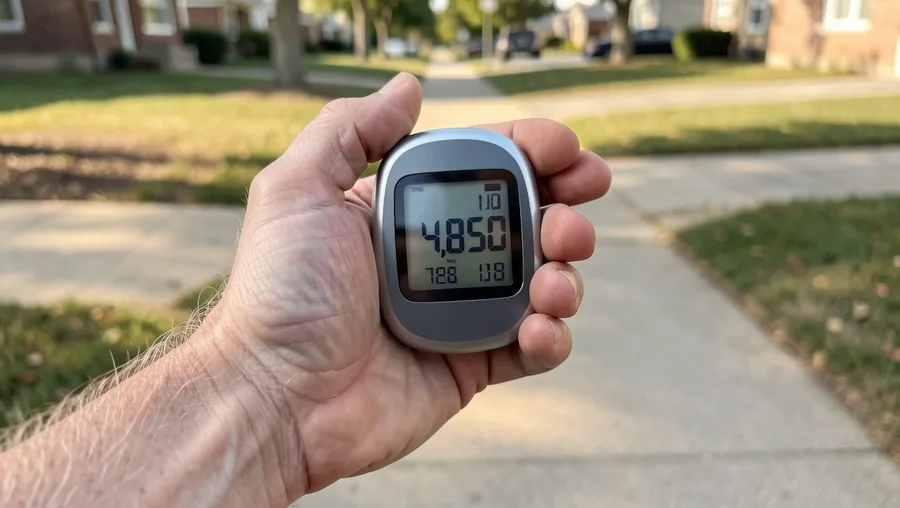
The number 10,000 did not originate in a research lab or a cardiology clinic.
It was created in Tokyo in 1965 to sell a pedometer named Manpo-kei, which translates literally to '10,000-steps meter.' The company chose the number because the Japanese character for 10,000 looks vaguely like a walking person. It was a brilliant marketing hook, but it was completely arbitrary.
Fitness app developers simply copied that 1965 marketing target into modern algorithms because it sounded neat and challenging.
Biological aging changes how your vascular walls respond to stress and how your cartilage handles repetitive force. Expecting a 68-year-old knee to thrive on the same volume as a 22-year-old marathon runner ignores basic biomechanics. What your physiology actually requires for cardiovascular protection and joint longevity is a far more reasonable figure.
⚠️ COMMON MISTAKE
Don't Let Default App Settings Guide Your Health
Most wrist trackers ship with 10,000 steps preset as the daily goal. Manually adjust your target in the app settings down to 5,000 steps to prevent false anxiety and track what medically matters for your demographic.
What Happens Inside an Aging Body at 4,000 Steps
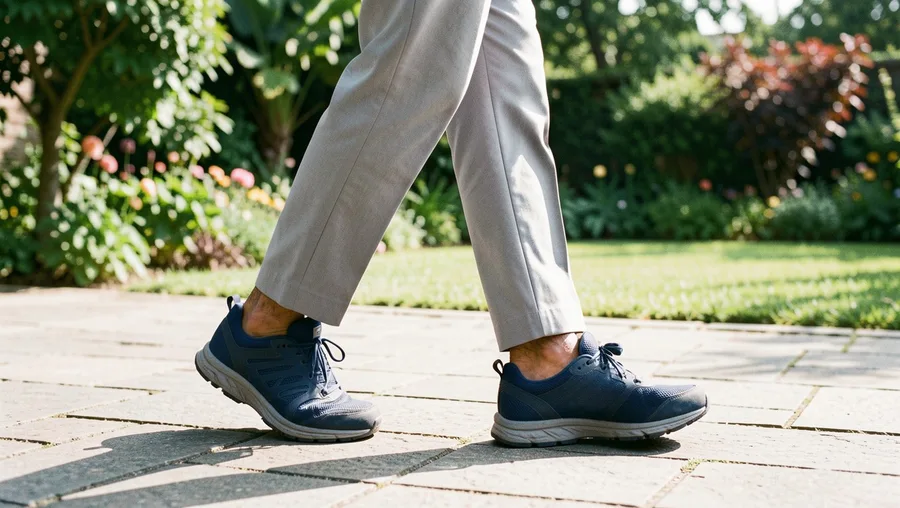
Your legs act as an auxiliary heart.
When you walk, the deep muscles in your calves contract against non-yielding fascia, squeezing the deep veins inside your lower leg. This calf-muscle pump propels blood upward against gravity, driving venous return to your heart and preventing fluid pool buildup around your ankles. At 4,000 steps, this mechanical pump has cycled thousands of times, dramatically easing arterial workload.
Inside your bloodstream, moderate movement activates a critical metabolic pathway.
Physical contraction of skeletal muscle signals GLUT4 glucose transporters to migrate to the surface of your muscle cells. These transporters clear sugar directly from your blood without demanding heavy insulin production from an aging pancreas. Meanwhile, your knee cartilage—which has no direct blood supply—relies on the rhythm of impact to sponge up nourishing synovial fluid.
The steep drop in mortality risk occurs between 3,000 and 7,000 steps. Beyond that, the curve flattens significantly for older adults.
— What preventive cardiologists and epidemiologists keep repeating
The Baseline Shift: Where the Steepest Risk Drop Happens
The relationship between movement and longevity is not a straight line.
Major meta-analyses published in major public health journals tracked over 47,000 adults across four continents to map step counts against mortality. The findings were undeniable: the most dramatic reduction in early death risk occurs when moving from a sedentary baseline of 2,000 steps up to roughly 4,500 steps per day.
This is the law of diminishing marginal returns in biological action.
Going from 2,000 steps to 4,000 steps cuts your cardiovascular risk significantly more than going from 7,000 steps to 9,000 steps. That initial bracket of movement restores vascular elasticity, clears post-meal glucose spikes, and calms systemic inflammation. If you only reach 4,500 steps on a busy day, you have already secured the vast majority of the biological benefit.
Step Volume vs. Biological Payoff — At a Glance
🩸 2,000–3,000 Steps
Base glucose regulation & reduced venous pooling
🫀 4,000–5,000 Steps
Major drop in all-cause mortality risk
🧠 6,000–7,000 Steps
Optimal brain volume & fall-prevention balance
🛑 8,000+ Steps
Longevity benefit plateaus for ages 60+
Key Takeaway
For adults over 60, public health data shows zero significant additional longevity gains beyond 7,500 steps per day.
The Longevity Plateau: Finding Your Personal Ceiling

More is not always better when joint restoration is the priority.
For adults aged 60 and older, mortality benefits reach a clear plateau between 6,000 and 8,000 steps per day. While younger adults under 60 continue seeing slight risk decreases up to 10,000 steps, older physiology hits its maximum protective efficiency much sooner.
Cadence matters, but total daily volume remains the primary engine.
Walking at a brisk pace of roughly 100 steps per minute stimulates mitochondrial biogenesis in your thigh muscles, enhancing energy output. However, if joint discomfort forces you to walk slower, do not worry. Accumulating 6,000 steps at a relaxed pace still preserves spatial gait variability, executive cognitive function, and the balance recovery mechanisms that protect you from falls.
The Non-Negotiable Factor: Consistency Over Heroic Distance

A single massive weekend trek cannot compensate for five days on the couch.
Physical therapists and geriatric researchers emphasize that 4,500 steps taken six days a week provides vastly superior vascular protection compared to hitting 12,000 steps on Sunday and remaining sedentary all week. Uninterrupted sitting for more than eight hours blunts arterial elasticity and reverses the positive endothelial gains of exercise.
Chunking your movement is just as effective as one long haul.
You do not need to block out an hour of continuous walking. Breaking your day into three 10-minute movement bouts—after breakfast, after lunch, and after dinner—delivers identical blood pressure reduction while placing far less continuous impact load on your hip and knee cartilage.
👟 A Stress-Free 5,500-Step Daily Routine
8:30 AM — Post-Breakfast Stroll
Take a calm 15-minute walk around the block to clear morning glucose spikes (1,500 steps).
12:30 PM — Midday Errand or Yard Loop
Spend 10 minutes moving while picking up mail or pottering in the garden (1,000 steps).
3:30 PM — Top-Hour Reset
Walk through the house for 5 minutes during phone calls or tea breaks (500 steps).
6:30 PM — Post-Dinner Neighborhood Loop
Complete a relaxed 25-minute walk with a spouse, friend, or dog (2,500 steps).
The Sustainable Step-Building Schedule
The Self-Check: How to Set Your Daily Target Without Injury

Never increase your step count based on what a friend or an article recommends.
Start with a 3-day baseline audit. Wear a simple pedometer or keep your phone in your pocket for three normal days without changing your routine, then average those numbers. That average is your true biological starting point.
Follow the 10 percent progression rule.
If your baseline is 3,200 steps, do not jump to 6,000 tomorrow. Add no more than 400 steps per day each week. This slow ramp allows your plantar fascia, Achilles tendons, and knee cartilage to adapt to mechanical load without triggering inflammatory flare-ups.
Adjust Your Step Target Down If You Experience
Building Daily Movement: Wise vs. Risky Strategies
Smart Movement Strategy
- Basing goals on your personal 3-day baseline average
- Splitting daily volume into 2–3 short, comfortable walks
- Increasing total daily steps by 10% per week max
- Prioritizing supportive shoes with thick heel cushioning
Overuse Injury Traps
- Forcing 10,000 steps because an app default demands it
- Attempting one long 60-minute trek after months of sitting
- Pushing through sharp knee or plantar fascia pain
- Walking on hard concrete in thin, unsupportive footwear
Joint Stress Spectrum by Walking Surface
Where to log your steps to protect aging hips and knees
- Smooth Dirt Path / Park Trails: Lowest impact; highly protective for cartilage.
- Rubberized Track / Asphalt: Moderate shock absorption; predictable footing.
- Concrete Sidewalks: High impact; hard on worn knee meniscus.
- Cobblestone / Uneven Concrete: High fall risk and heavy tendon shear force.
The Longevity Walking Hierarchy
Build your daily habit from foundation to fine-tuning
Moving Forward on Your Own Terms
True physical freedom after 60 is not measured by an arbitrary 5-digit number on a wrist gadget.
It is measured by your ability to carry groceries without back spasms, walk through a botanical garden without knee pain, and maintain steady blood sugar levels year after year. The science is officially on your side: 4,000 to 7,000 steps per day provides all the cardiovascular and longevity protection you need.
Put down the pressure, adjust your app targets, and take a simple 15-minute walk today. Your legs, heart, and joints will thank you for years to come.
Your Next Step Today
If you do only one thing after reading this, check your tracker's history to find your actual 7-day average. Drop your daily target goal in the settings to 5,000 steps.
Give yourself permission to celebrate hitting that realistic metric, and let consistency do the heavy lifting for your health.

Meet Edward Green, the founder of GolfingGoal and a seasoned expert in golf. With years of experience on the course and a passion for the sport, Edward has a wealth of knowledge to share. As our Lead Writer, he contributes articles, tutorials, and resources to help readers to improve their skills and reach their full potential on the golf course. Join Our Team!