

You reach the bottom of the stairs, realize you left your coffee upstairs, and groan at the prospect of the climb. It is not just the fatigue that bothers you, but the nagging feeling that your body is moving through the world with a little more friction than it did five years ago. You did everything right, but the daily movements seem to be taking a larger toll on your joints and energy levels.
The sit-to-stand test is a validated clinical metric that measures lower-limb strength and functional power, offering a crystal-clear window into your future autonomy. It is not a gimmick, but a powerful, no-equipment indicator of how your body will hold up over the next decade. By the end of this, you will know exactly where you stand—and what to do about it.
💡 PRO TIP
A Vital Biomarker
Research consistently shows that physical performance scores in middle age are among the strongest predictors of cardiovascular health and independence at age 80.
The Biology of the Stand

Standing up from a chair is a complex task that your brain often handles unconsciously. It requires a precise sequence of core stabilization, quadriceps power, glute engagement, and neuromuscular coordination that relies on your entire lower kinetic chain.
As we hit our 50s and 60s, a process called sarcopenia—or age-related muscle mass loss—begins to target these specific muscle groups first. This loss is rarely felt during daily walks, but it becomes obvious the moment you need to generate quick, forceful power, like rising from a couch.
Your nervous system plays a part, too. Proprioception, your body's ability to sense its position in space, tends to dull over time. When your muscles and nerves stop communicating efficiently, simple movements start to feel clunky. You are not just fighting muscle loss; you are training your brain to trust your legs again.
How to Perform the Test Properly
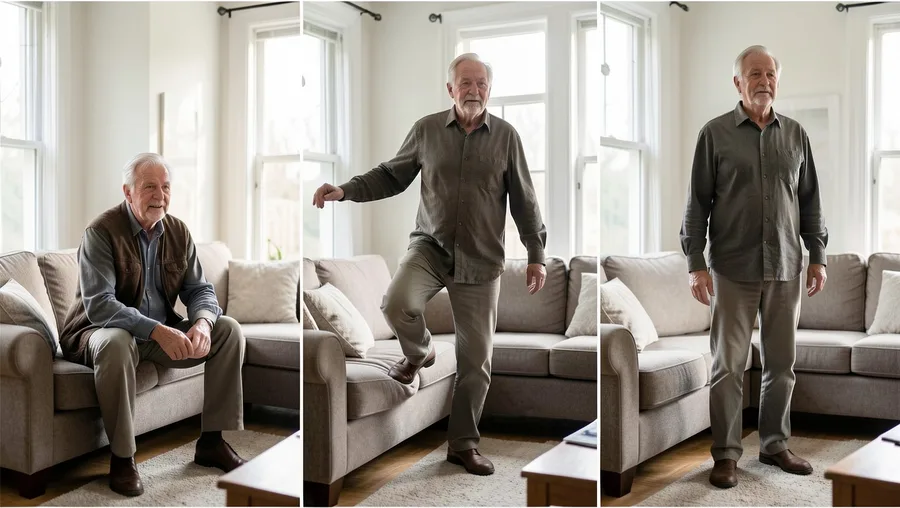
Before you begin, grab a standard dining chair without armrests, ensuring it is sturdy and won't slide. The seat height should be between 17 and 18 inches, which is the standard measure used in most clinical protocols to ensure consistency.
The protocol: Sit in the center of the chair, back straight, with your feet flat on the floor about hip-width apart. Cross your arms over your chest, keeping your hands touching your opposite shoulders. Stand up to a full, upright position and sit back down completely for one rep.
Repeat this as many times as you can for 30 seconds. Do not push off with your hands, as that negates the strength measurement. If you feel dizzy, unstable, or have sharp joint pain, stop immediately.
⏱️ Your Testing Protocol
Setup
Ensure your chair is on a non-slip rug or surface.
Form Check
Keep your arms crossed and your eyes looking straight ahead.
The Effort
Perform as many reps as possible with good control.
The Record
Note your total successful reps and your fatigue level.
Interpreting Your Score
Your score is a snapshot of your current functional fitness level. It is not a diagnostic tool for chronic disease, but it is a highly accurate barometer for physical frailty risk.
For adults aged 60 to 69, completing fewer than 10 to 12 repetitions in 30 seconds is generally considered below average and suggests a need for targeted strength training. Men and women have slightly different baselines, but the trend line is identical: higher reps correlate with lower fall risks and better longevity outcomes.
Remember that speed is secondary to control. If you find yourself collapsing into the chair or using momentum to jerk your body upward, your score is inflated. Quality movement builds the muscle that actually protects your hips and knees in the long run.
Performance Baseline — At a Glance
👤 Age 50–60
14–19 reps
👤 Age 60–70
12–17 reps
👤 Age 70–80
10–14 reps
⚠️ Low Score
Under 8 reps
The Takeaway
Consistent, controlled movement is more valuable than raw speed.
The Scientific Consensus
Researchers often argue about the best way to measure longevity, but they rarely disagree on the value of lower-body power. The scientific community views this test as a reflection of your 'functional age' versus your chronological age.
There is a persistent myth that strength decline after 60 is inevitable and irreversible. This is false. Disuse atrophy—the weakening of muscle due to lack of use—is actually the culprit behind most performance declines in this age group, not the simple passage of time.
Your body is incredibly adaptive. Even with modest, consistent loading, you can force your muscle fibers to retain their power. The goal isn't to look like a bodybuilder; it is to maintain the mechanical integrity required to navigate your world without fear of a fall.
The Movement Split
The Right Way
- Controlled, slow descent
- Heels planted firmly
- Chest up and open
- Smooth, rhythmic tempo
The Common Pitfalls
- Collapsing onto the seat
- Lifting heels mid-rise
- Rounding your shoulders
- Using momentum to jerk
Terms You Should Know
The Next 10 Years Action Plan

If you want to improve your score, stop focusing on 'working out' and start focusing on 'working your capacity'. Start by practicing the sit-to-stand movement daily, but change the tempo to maximize the effort.
The daily drill: Perform 3 sets of 10 repetitions twice a day. The trick is the tempo: count three seconds on the way down to the chair, pause for one second, and stand up in one fluid, explosive motion. That slow descent is exactly what strengthens your tendons and bone density.
Finally, ensure your nutrition supports this. After 50, your body becomes less efficient at processing protein. Aim for 25 to 30 grams of high-quality protein at each meal, specifically focusing on leucine-rich sources like eggs, Greek yogurt, or lean chicken, to provide the raw materials for your muscle repair.
Daily Practice Investment
⚠️ COMMON MISTAKE
Avoid The Momentum Trap
Many people try to speed up their score by jerking their torso forward to create momentum. This puts unnecessary strain on your lower back and does nothing to improve your actual leg strength.
Common Questions About the Test
What if I have knee pain? Consult a physical therapist first. Often, knee pain during this movement is caused by weak glutes that force the knees to take too much load. Focus on controlled, shallow movements that don't trigger the sharp pain, gradually increasing the depth as your strength returns.
Is this test valid if I have back issues? Absolutely, provided you keep your core engaged. Think of bracing your stomach as if someone is about to poke you. This keeps your spine neutral and prevents the 'hinging' at the waist that often causes discomfort.
Does speed matter more than form? Never. Speed is the enemy of form. You are better off doing five slow, perfect repetitions than fifteen rushed, sloppy ones. Consistency is what triggers the physiological change in your muscle fibers.
When to Skip
Building the Foundation for Your Next Decade
You do not need a gym membership or an expensive trainer to assess and improve your functional baseline. Your ability to stand from a chair unassisted is the single most actionable metric you have for predicting—and improving—your physical independence for the next ten years.
Start today. If you can only manage three reps before your legs shake, that is your baseline. Do that every day this week, and watch how quickly the capacity shifts. Your body is ready to adapt, provided you give it the signal.
The Progression

Meet Edward Green, the founder of GolfingGoal and a seasoned expert in golf. With years of experience on the course and a passion for the sport, Edward has a wealth of knowledge to share. As our Lead Writer, he contributes articles, tutorials, and resources to help readers to improve their skills and reach their full potential on the golf course. Join Our Team!