You open your browser, bookmark twelve wellness tabs, and fall asleep twenty minutes later without retaining a single protocol.
That endless scroll feels like learning, but it is actually just sophisticated procrastination disguised as productivity.
True mastery requires swapping passive consumption for active curation so you can evaluate health claims like a clinical researcher.
The Illusion of Competence in the Age of Infinite Feeds

Passive content consumption tricks your brain into feeling productive while leaving your actual knowledge base completely empty.
Recognizing a term on a podcast is entirely different from understanding the underlying biological mechanism.
Self-educating like a polymath demands strict curation over mindless accumulation.
⚠️ COMMON MISTAKE
Stop the Infobesity Trap
Saving hundreds of articles to a read-later app creates a false sense of accomplishment. Build a rule to process or discard every piece of information within twenty-four hours.
The Neuroscience of How Your Adult Brain Encodes Complex Data

The adult brain requires deliberate friction to build new neural pathways and strengthen existing synapses.
Synaptic pruning and myelin sheath reinforcement happen only when you actively struggle through difficult material rather than skimming summaries.
Cognitive load theory splits your mental bandwidth into intrinsic, extraneous, and germane categories.
The Cognitive Load Triangle
🧠 Intrinsic Load
Difficulty of the core topic
🗑️ Extraneous Load
Poorly formatted study materials
⚡ Germane Load
Mental effort used to build schemas
🎯 Target Ratio
Minimize extraneous, maximize germane
Optimization Rule
Clear away messy secondary explanations so your brain can dedicate full bandwidth to germane schema building.
Four Systematic Pillars for Curing Health Data Blind Spots
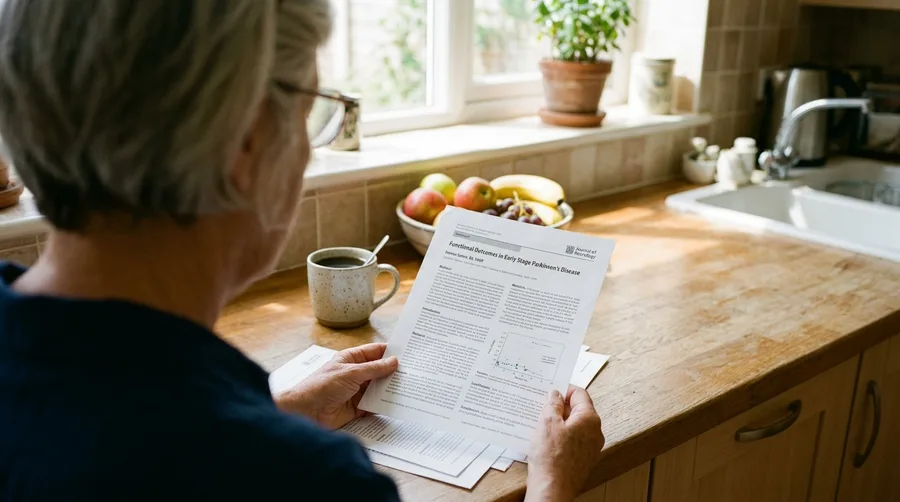
Reliable self-education begins with mapping primary sources rather than relying on watered-down secondary summaries.
You must master the hierarchy of evidence by separating randomized controlled trials from weak observational cohort studies.
Always audit conflicts of interest and funding sources before adopting any new biological protocol.
Primary Literature vs. Secondary Media
Primary Sources
- Direct access to raw statistical analysis
- Transparent disclosure of study limitations
- Clear breakdown of methodology and bias
Secondary Summaries
- Sensationalized headlines for clicks
- Omitted sample sizes and confounding variables
- Hidden commercial sponsorships
The Feynman-Plus Protocol for Turning Raw Data into Expertise

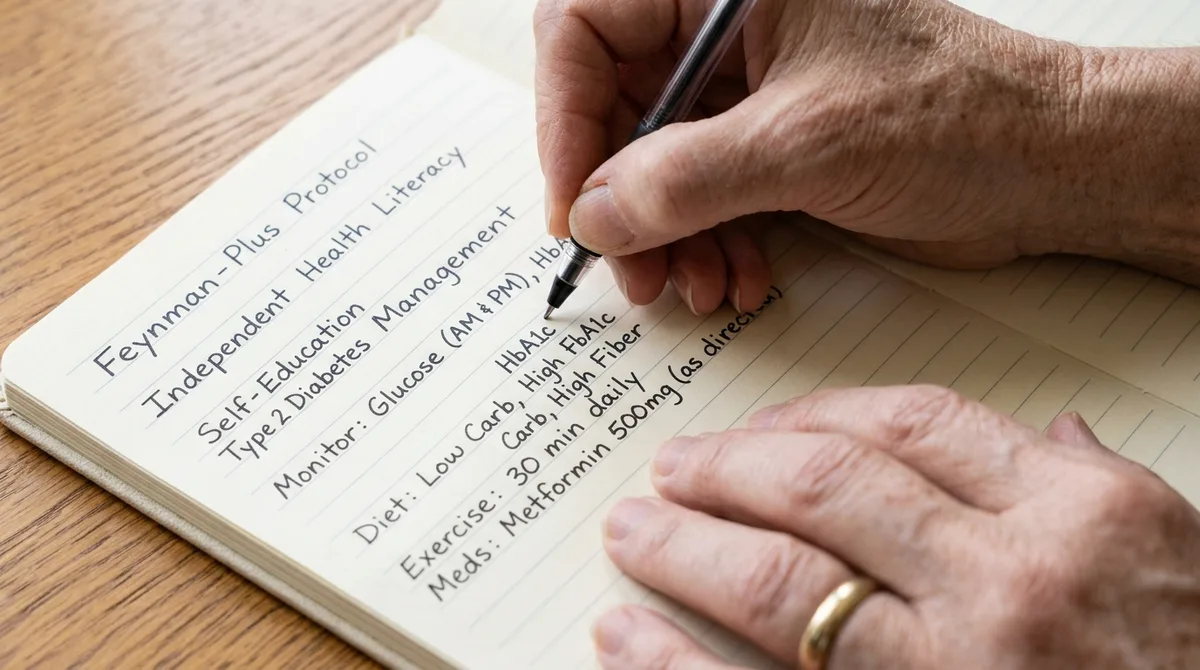
Strip away academic jargon by translating complex biological processes into plain-language analogies.
Isolate the exact vocabulary gaps where your mental model breaks down.
Rebuild the mechanism from first principles by asking why until you reach cellular or physiological roots.
🔄 The 4-Step Feynman Execution Loop
Simplify
Explain the biological mechanism using everyday language.
Isolate Gaps
Pinpoint the exact terms or steps where your explanation fails.
Rebuild
Return to source literature to patch the missing biochemical links.
Stress-Test
Apply the concept to edge cases and individual variations.
Quick Comprehension Flow
Where Institutional Medical Consensus Meets Independent Study

Independent research serves as a powerful supplement to personal health literacy, but it never replaces individualized clinical judgment.
Confirmation bias frequently traps self-taught learners inside niche echo chambers where disconfirming evidence is ignored.
Recognize the exact ethical boundary where consumer health research stops and clinical intervention must begin.
💡 PRO TIP
Audit Your Echo Chamber
Active learners deliberately seek out papers that contradict their current wellness beliefs. If your reading list never challenges your baseline assumptions, you are just reinforcing biases.
True self-education is not about gathering more information, but about upgrading your personal curation filters.
— The Self-Education Standard
The Health Literacy Audit: Evaluating Your Learning Habits

Test your real-world comprehension by trying to explain the cellular pathway of your current wellness routine to an absolute novice.
Track the origin of every health claim you share or implement into your daily schedule.
Actively rotate your information sources to prevent stagnation and cognitive bias.
The Seven-Day Study Rhythm
Information Bias Spectrum
Tracking your vulnerability to unverified health claims
- Rigorous Primary Review: Safe, evidence-based baseline
- Secondary Meta-Analysis: Generally reliable insights
- Algorithmic Social Feeds: High risk of sensationalism
- Unverified Anecdote: Severe risk of misinformation
Frequently Asked Questions
How many hours a week does it take to maintain high-level health literacy?
Dedicate three to four focused hours per week to reading primary literature. Quality curation always beats high-volume passive skimming.
What are the best open-access databases for reading raw medical studies?
PubMed, PubMed Central, and Google Scholar provide free access to millions of peer-reviewed biomedical papers and systematic reviews.
How do I filter out pseudo-scientific health advice on social media?
Always demand primary source citations. If a creator relies on dramatic emotional hooks without linking direct clinical trials, disregard the claim.
Should I focus on general longevity science or deep-dive into specific conditions?
Start with general metabolic health and cellular biology foundations before narrowing your focus into specific pathological mechanisms.
How do I retain what I read without taking exhaustive notes?
Use the Feynman technique to summarize the core biological mechanism in five sentences or less immediately after finishing the material.
Build Your Personal Research Engine Today
Transforming from a passive content consumer into an active self-educator starts with changing how you process incoming claims.
Pick one primary literature source this week, audit a single health claim you currently rely on, and apply the Feynman protocol to lock in the mechanism.

Meet Edward Green, the founder of GolfingGoal and a seasoned expert in golf. With years of experience on the course and a passion for the sport, Edward has a wealth of knowledge to share. As our Lead Writer, he contributes articles, tutorials, and resources to help readers to improve their skills and reach their full potential on the golf course. Join Our Team!