

“I just don’t trust my feet anymore.”
Doctors hear some version of that sentence every single day. From people who used to hike. People who danced. People who simply want to walk to the mailbox without gripping the railing.
Balance complaints are among the most common reasons adults over 65 visit their doctor. They are also among the most misunderstood. People assume it is just age and nothing can be done. Doctors disagree. Most balance problems have a cause, and many causes have a fix.
Here are the four complaints doctors hear most, what each one usually means, and what physicians actually do about them.

Balance is a team effort

Before the complaints, a quick tour of the machinery. Staying upright takes three systems working together.
First, your inner ears. Deep inside each ear sit tiny organs that sense head position and motion. Second, your eyes, which tell your brain where you are in space. Third, your muscles and nerves, which make constant small adjustments to keep you steady. Your feet also feed information upward about the ground beneath you.
Here is the key insight physicians like Dr. Keith Roach emphasize: the body can usually cope when one system falters. Your eyes compensate for a wobbly inner ear. Your muscles compensate for poor vision. Trouble starts when two or three systems weaken at once. That is when falls happen.
This is also why balance problems in older adults are rarely one simple thing. They are usually a combination, which means the solutions are usually a combination too.
Complaint one: “I get dizzy standing up too fast”

You rise from the couch. The room tilts. For a few seconds, you hold the armrest and wait for the world to settle.
This is often a blood pressure dip. When you stand, gravity pulls blood downward, and your body has a split second to redirect it upward to the brain. With age, that response can lag. The result is lightheadedness, sometimes called orthostatic hypotension.
Dehydration makes it worse. So do several common medications, including blood pressure drugs, diuretics, and some antidepressants. This is one reason doctors review medications at every visit, looking for drugs that can be reduced, swapped, or stopped.
Simple habits help: stand up slowly, sit on the bed edge for a moment in the morning, and drink water through the day. If the dizziness is frequent or you actually faint, that is a doctor visit, not a waiting game.
Complaint two: “The room spins when I turn over in bed”

This one has a specific signature. You roll over, look up, or bend down, and suddenly the room is spinning. It lasts less than a minute, then passes. Then it happens again the next time you move that way.
Doctors hear this and think of BPPV, short for benign paroxysmal positional vertigo. The cause is almost poetic: tiny calcium crystals in the inner ear that sense gravity can break loose and drift into the wrong canal. When you move your head, the drifting crystals send false spinning signals.
ENT specialists note that BPPV is the most common cause of vertigo in older adults, and it is highly treatable. A doctor or physical therapist can perform a series of guided head movements that roll the crystals back where they belong. Many people feel better after one or two sessions.
The word “benign” is doing heavy lifting in the name. The condition is not dangerous, but the falls it causes can be. Do not just live with the spinning. It is fixable.
Complaint three: “I just feel unsteady on my feet”

No spinning. No dizziness. Just a general sense that your footing is not what it was. You walk more carefully. You avoid uneven ground. Stairs require full concentration.
This is the most common complaint of all, and it usually traces back to the team effort breaking down. Leg muscles weaken with age, especially if activity drops. Vision changes make it harder to judge distances and spot hazards. Nerve damage in the feet, common with diabetes, dulls the feedback from the ground.
Arthritis adds its own trouble. Stiff, painful joints in the hips, knees, or ankles change how you walk, and an altered gait is a less stable gait.
The fix is refreshingly direct: rebuild what weakened. Strength and balance exercises retrain the muscles and the reflexes together. Harvard physicians recommend simple home moves like standing on one leg, walking heel to toe, and shifting weight side to side. Tai chi and yoga add coordination on top of strength. Eyes get checked. Feet get checked. Each system gets its tune-up.
Complaint four: “I’m scared of falling, so I move less”

This is the complaint people confess quietly, almost embarrassed. They have started declining invitations. They take the elevator for one floor. They hold walls in their own hallway.
Doctors take this one very seriously, because fear creates a trap. Less movement leads to weaker muscles and stiffer joints. Weaker muscles lead to worse balance. Worse balance leads to more fear. Around and around it goes, and the fall risk climbs with every lap.
Breaking the cycle does not require bravery. It requires a plan and a handrail. Start with supported exercises, holding a sturdy chair or counter. Add short walks on familiar, even ground. Consider a physical therapist, who can build a program matched to exactly where you are.
Confidence returns faster than people expect. Each steady week makes the next one easier.
What doctors check first

When you bring a balance complaint to your doctor, here is roughly what happens behind the curtain.
Medications come first. Many practices review every drug at every visit, hunting for ones that cause dizziness, lower blood pressure, or interact badly in combination. Never stop a medication on your own, but do bring a full list, including over-the-counter pills and supplements.
Next come the senses. When was your last eye exam? Any hearing changes? Both feed the balance system. Then strength and joints: can you stand from a chair without using your hands? How is your gait?
Healthline’s review of the evidence adds home safety to the checklist: grab bars, better lighting, cleared clutter, and supportive nonslip shoes. About one in four Americans over 65 falls each year, according to the CDC, and many of those falls start with a loose rug or a dark hallway.
A brief honesty note: this article is information, not medical advice. Balance problems can occasionally signal something urgent, like a stroke or heart issue. Sudden severe dizziness, especially with weakness, slurred speech, or chest pain, needs emergency care, not an article.
Simple ways to steady yourself
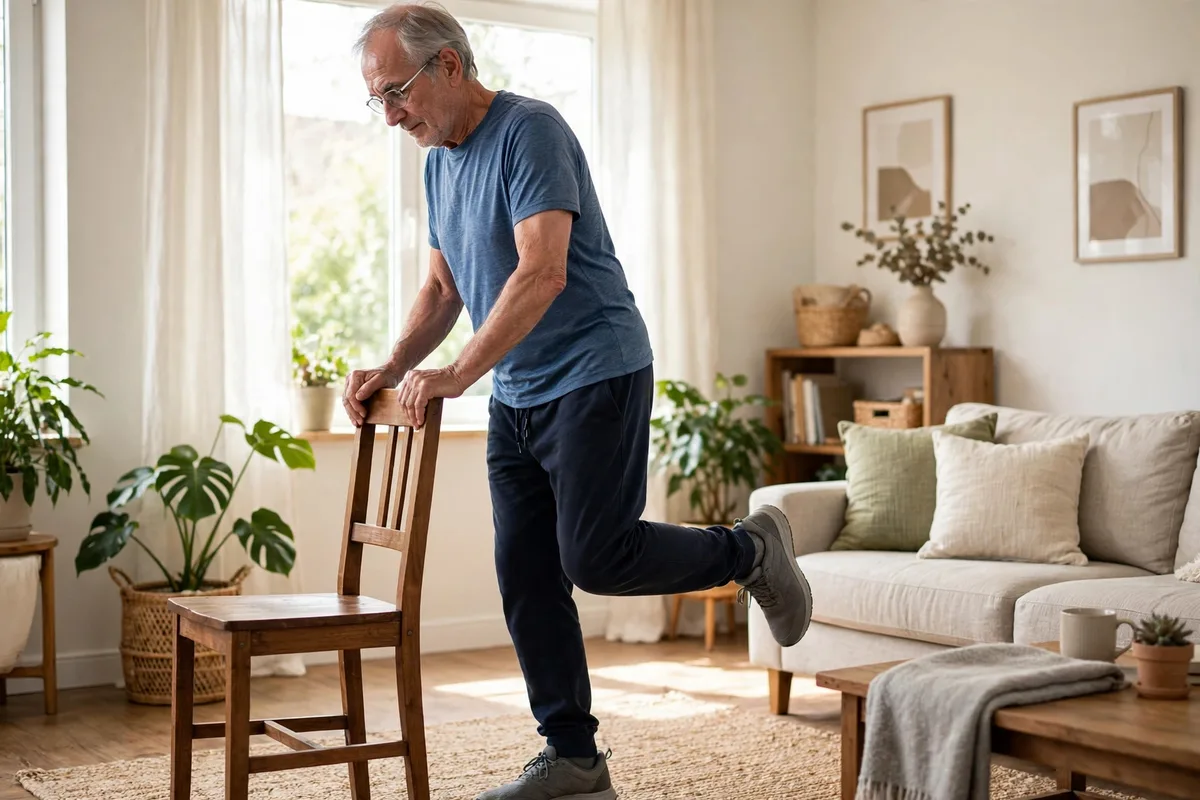
You do not need a gym. You need a chair, a counter, and a few minutes.
Try the single-leg stand: hold a sturdy chair, lift one foot a few inches, and balance. Aim for a few seconds at first, working toward thirty. Try heel-to-toe walking down a hallway, arms out for balance. Try standing up from a chair without using your hands, which builds the exact leg strength that daily life demands.
Tai chi deserves special mention. Its slow, deliberate weight shifts are practically a balance laboratory, and classes for seniors are common at community centers. Yoga works too, with an experienced instructor.
Pair the exercises with the environment. Good lighting everywhere, especially stairs and bathrooms. Handrails where you need them. Shoes with grip, not slick soles. Small changes, compounding daily.
Steady wins

Balance is not a gift you lose with age. It is a skill you maintain, like any other.
The four complaints all point somewhere useful. Dizziness on standing points to blood pressure and medications. Spinning in bed points to the inner ear. Unsteadiness points to muscles, eyes, and nerves. Fear points to a cycle that can be broken.
Bring the complaint to your doctor. Then do the exercises. Steady is not a young person’s game. It is a practice, and it is never too late to start.

Eliza Mercer, the renowned golf coach with unmatched expertise in the sport, is our Lead Instruction Coach. Eliza provides exclusive and personalized coaching sessions to help golfers of all levels improve their skills. With her wealth of knowledge and experience, Eliza is a valuable resource for readers looking to elevate their game. Join Our Team!