
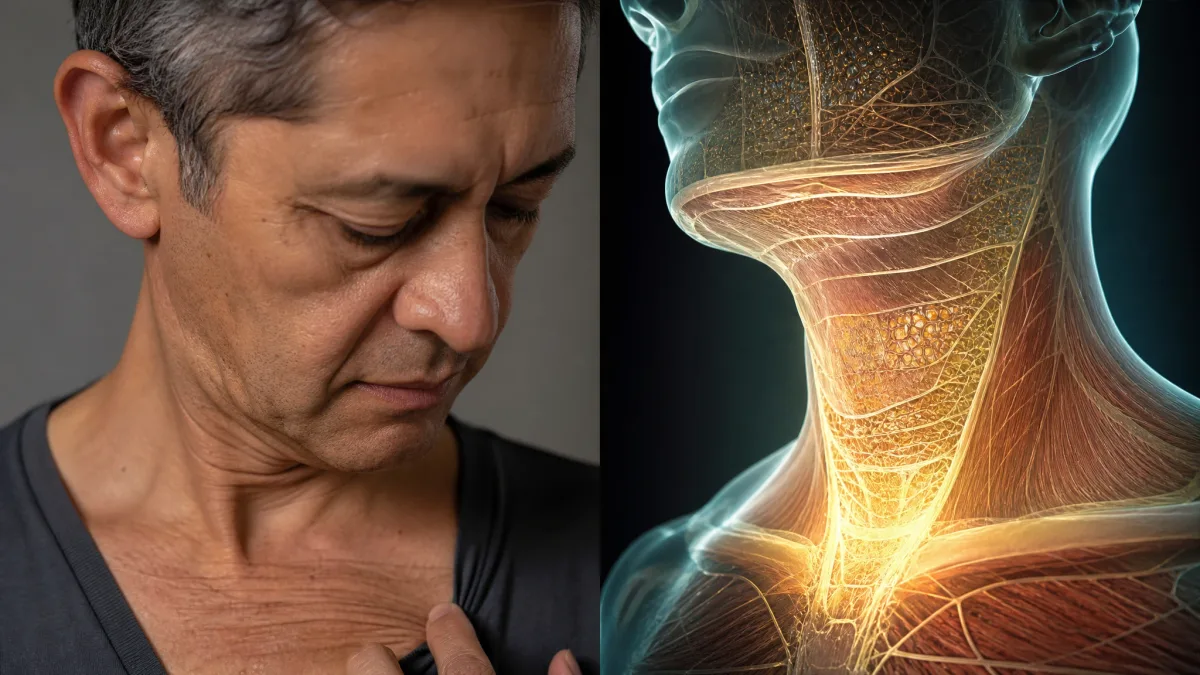
You finish tapping in your nightly eye serum.
You look in the mirror and notice a distinct boundary right at your jawline. Above it, the skin is plump and aggressively hydrated, but below that line sits a completely different reality of crepey texture and neglected sun damage.
The visual contrast is impossible to unsee once you finally notice how much your neck has aged.
Most women over 50 invest heavily in facial skincare while treating the neck and chest as a total afterthought. Dermatologists consistently emphasize that this is a massive oversight that leaves your most vulnerable skin exposed to the elements.
Your neck requires immediate structural intervention.
Because these lower zones lack the structural support and natural oils of your face, they age at a significantly faster rate. By extending your routine just six inches lower, you can protect this delicate tissue before irreversible thinning sets in.
It is time to erase the artificial boundary at your chin and start treating your entire upper body with respect.
Quick Check: Where Does Your Routine End?
Why Neck and Chest Skin Ages So Differently

Your neck is not just an extension of your face.
The cellular structure here is remarkably fragile, featuring a significantly thinner dermis and a dramatic drop in sebaceous gland density. Without those natural oils, the skin on your décolletage cannot retain moisture or repair its own barrier effectively after menopause.
This zone also faces constant, unavoidable mechanical stress from how you sit, stand, and sleep every single day.
Every time you look down at a screen or sleep on your side, you fold that delicate tissue in half. Over decades, this repetitive motion breaks down the sparse collagen network, while unprotected UV exposure through car windows accelerates the damage.
Gravity and friction constantly work against your chest.
Unlike the face, which sits over a sturdy foundation of bone and fat pads, the neck area is essentially free-floating skin draped over muscle. When collagen depletes here, the resulting structural sagging is much harder to reverse with topical creams alone.
Understanding these physiological limitations is the first step toward building a protocol that actually addresses the root causes of aging.
Facial Skin vs. Neck & Chest Skin
Facial Tissue
- Thicker dermal layer
- High density of sebaceous glands
- Supported by bone structure
- Faster cellular turnover rate
Neck & Chest Tissue
- Fragile, thin dermal barrier
- Minimal natural oil production
- Subject to constant mechanical folding
- Prone to severe trans-epidermal water loss
1. Extending Active Treatments Beyond the Jawline

Your face does not stop at your chin.
Dermatologists consider the face, neck, and upper chest to be a single cosmetic unit that requires the exact same foundational ingredients. If a retinoid or chemical exfoliant goes on your cheeks, it belongs right on your collarbones too.
However, because neck tissue is thinner, it reacts furiously to high-percentage actives if you rush the application process.
The practical fix is buffering your potent treatments with a lightweight ceramide lotion before applying them below the jaw. Start twice a week, pressing the product gently into the skin instead of aggressively rubbing it in.
Slow and steady prevents painful contact dermatitis.
By laying down a hydrating base layer first, you slow the absorption rate of the active ingredient. This allows the delicate neck tissue to acclimate to cell-turnover agents without experiencing the angry red flushing that makes people quit.
Over time, you can gradually increase the frequency until your entire décolletage handles nightly treatments just like your face.
🧴 The Downward Application Technique
Cleanse and Dry
Start with completely dry skin on your neck to reduce immediate absorption spikes.
Apply Buffer Layer
Spread a thin layer of basic ceramide lotion over the neck and chest.
Press in Actives
Gently press your retinoid into the buffered skin using flat palms.
Seal with Moisture
Finish with a heavier cream to lock the treatment in overnight.
2. Daily UV Defense for the Décolletage

Morning sunlight compounds quietly on your exposed chest.
Even if you never burn, incidental UV exposure from driving to work degrades collagen in the exact V-shape of your favorite shirts. Most people mistakenly think their quarter-teaspoon of facial SPF provides enough residual coverage to protect this entire extended area.
It absolutely does not, and spreading it too thin leaves your décolletage completely vulnerable to ongoing photoaging.
You need a dedicated, nickel-sized dollop of sunscreen specifically assigned to the neck and upper chest every single morning. Because this area is highly prone to heat rash, mineral filters like zinc oxide often perform much better than chemical alternatives for readers over 50.
Consistency matters more than finding a perfect formulation.
Apply your sun protection daily, even in winter, to halt the progression of structural degradation. If you rely on scarves or high collars during colder months, remember that UVA rays easily penetrate standard woven fabrics and office windows.
Making this step a non-negotiable morning habit is the single most effective way to prevent crepey texture from forming.
⚠️ COMMON MISTAKE
The Perfume Trap
Spraying alcohol-based fragrance directly onto your chest right before walking out into the sun causes severe photosensitivity and accelerates dark spots.
How Daily Exposure Compounds
3. Gentle Cleansing Over-Strip Prevention

Harsh body washes are destroying your chest barrier.
Step into the shower and you probably wash your upper body with heavily fragranced, sulfate-rich gels that aggressively strip away essential lipids. Using these foaming formulas on your fragile chest skin guarantees chronic dryness, irritation, and accelerated micro-tearing over time.
The rule is simple: whatever gentle, non-foaming cleanser you use on your face should migrate down your neck.
If you enjoy physical exfoliation, abandon rough body scrubs above the shoulders entirely right now. A soft, warm washcloth paired with a ceramide-infused cream cleanser removes daily grime perfectly without compromising the already sparse moisture barrier of your upper chest.
Treat your décolletage like delicate silk, not heavy canvas.
Post-menopausal skin simply cannot recover quickly from intense lipid removal, leaving it vulnerable to environmental damage all day long. By treating the shower as the first step of your skincare routine, you preserve the natural oils your neck desperately needs.
Simply swapping out your bar soap for a hydrating facial cleanser will visibly improve your skin texture within two weeks.
4. Posture and Mechanical Stress Management

Modern technology is etching deep lines into your neck.
Spending four hours a day gazing downward at a mobile phone forces your neck skin to fold repeatedly in the exact same creases. Over time, this sustained mechanical flexion transforms temporary wrinkles into deep horizontal rings that topical creams cannot erase.
Sleep posture creates a very similar issue when side-sleeping compresses the chest for eight unbroken hours a night.
Correcting this requires physical and ergonomic intervention rather than another expensive skincare purchase. Raise your computer screens to direct eye level during the day, and actively practice holding your phone up rather than dropping your chin to your chest.
Your daily habits shape your skin structure physically.
At night, use a specialized sleep bra or a targeted cervical pillow to keep the chest physically open. Preventing those deep compression folds from forming while you sleep stops vertical creasing before it can become permanently stamped into the dermis.
Small positional adjustments make a massive difference in how the skin on your upper body ages over the next decade.
Ergonomic Adjustments for Crease Prevention
💻 Monitor Height
Top third of screen at eye level
📱 Phone Posture
Held up at chest height, not lap
🛌 Sleep Position
Supine (back sleeping) is ideal
🛏️ Pillow Support
Cervical contour pillow
Why It Works
Removing the mechanical folding action stops collagen fibers from physically breaking along the crease line.
Hierarchy of Posture Fixes
5. Targeted Barrier Repair and Peptide Support

Your neck needs targeted structural support every single night.
Because the décolletage cannot naturally produce enough lipids after menopause, you must supply them artificially through targeted topical formulas. Heavy anti-aging facial creams often contain aggressive resurfacing acids that overwhelm the neck, while standard body lotions completely lack necessary firming agents.
You need a dedicated middle ground formula rich in signal peptides and ceramides to rebuild the extracellular matrix proteins.
Apply a thick, occlusive layer of rich peptide cream before bed to seal all that essential hydration deeply into the skin. This prevents trans-epidermal water loss and gives your compromised skin barrier the exact building blocks it needs to repair cellular damage.
Hydration is the ultimate defense against crepey texture.
When the neck and chest remain thoroughly moisturized overnight, the skin plumps up temporarily, smoothing out fine lines by morning. More importantly, this continuous moisture supply prevents the dermal layer from thinning out further as estrogen levels naturally decline.
Investing in a moisturizer formulated specifically for thinner skin zones guarantees your décolletage gets exactly what it requires.
Neck & Chest Product Ingredients
- Ceramides & Peptides — Excellent for rebuilding the barrier without causing irritation.
- Retinoids — Highly effective, but must be buffered and introduced slowly to avoid redness.
- Harsh Physical Scrubs — Causes micro-tearing and damages the already fragile skin structure.
Best Candidates for Targeted Peptides
Moving from Frustration to Daily Prevention

Chasing deep, established lines is a frustrating losing game.
Once horizontal neck rings and leathery chest texture fully set in, topical products offer only modest, temporary improvements. The sheer frustration of trying to reverse decades of neglect often causes people to abandon neck care entirely, assuming the damage is permanent.
You must consciously shift your mindset from aggressive, expensive correction to consistent, daily barrier defense.
Integrating your neck and chest into your morning and evening routines takes exactly thirty extra seconds of your time. By treating the entire cosmetic unit consistently every single day, you build a cumulative structural resilience that pays off dramatically as you age.
Prevention is far cheaper and more effective than repair.
Rather than viewing chest care as an exhausting chore, reframe it as a direct extension of basic daily hygiene. When you remove the friction of separate routines, you are much more likely to actually stick with the habits long enough to see results.
A simple, consistent routine you do every day will always outperform a complex regimen you only manage once a week.
💡 PRO TIP
The 30-Second Habit Shift
Keep your body lotion on a completely different shelf, and move your neck cream right next to your facial serums so you apply them simultaneously every night.
Frequently Asked Questions
Can I use my regular facial retinol on my neck?
Yes, but you must buffer it with a moisturizer first. Neck skin is thinner and reacts aggressively to direct application, so start twice a week to build tolerance slowly.
Why does my chest flush easily when applying active ingredients?
The décolletage has a thinner stratum corneum and a more superficial capillary network. This structural difference means ingredients penetrate faster, causing temporary vasodilation and visible redness.
At what age should I start extending routines to my chest?
Dermatological consensus strongly recommends treating the neck and face as one unit starting in your early twenties. However, adopting these protective habits after 50 still significantly slows further structural breakdown.
Do neck exercise devices or firming gadgets actually work?
There is very limited clinical data supporting the efficacy of these physical devices. Most dermatologists suggest focusing your time and budget on topical barrier protection and daily posture adjustments instead.
How much sunscreen do I actually need for my neck and chest?
You need approximately a nickel-sized amount dedicated entirely to the V-zone of your chest and neck. Relying on whatever is left over from your face leaves you practically unprotected.
Beyond the Jawline: Your New Daily Habit Blueprint
Your skincare routine is stopping too high up.
The absolute simplest way to protect your neck and chest is to stop thinking of them as entirely separate body parts. Every active ingredient, thick moisturizer, and mineral sunscreen you apply to your face belongs on your collarbones as well.
Tonight, when you reach for your gentle cleanser and hydrating evening serums, simply keep moving your hands smoothly downward.
Do not stop at the chin.

Meet Edward Green, the founder of GolfingGoal and a seasoned expert in golf. With years of experience on the course and a passion for the sport, Edward has a wealth of knowledge to share. As our Lead Writer, he contributes articles, tutorials, and resources to help readers to improve their skills and reach their full potential on the golf course. Join Our Team!