
You catch your reflection in a store window and feel a sudden, jarring shock.
Inside, you feel energetic, vibrant, and entirely capable. Yet the silhouette staring back at you appears heavy, collapsed, and prematurely aged by a decade.
That unexpected disconnect happens not from facial wrinkles, but from a gradual, unmonitored structural collapse. Gravity is a relentless architect.
Over time, unconscious daily positioning rewrites your skeletal alignment. We will look at the exact six habits causing this shift and how to reverse them today.
💡 PRO TIP
Understanding Postural Creep
Postural creep is the slow, silent descent of your frame into gravity. Because it happens over years without pain, your nervous system accepts the slouch as the new normal.
The Mechanics of Compression: How Bad Alignment Ages the Silhouette

Before addressing daily habits, you must understand the physics of spinal loading.
For every single inch your head drifts forward, the cervical spine experiences a doubling of effective load. Your neck muscles strain endlessly to hold that weight.
This constant tension pulls your shoulders upward and inward, creating a compressed, shortened neck. It is a visual shortcut for advanced age.
Simultaneously, a collapsed ribcage restricts your lung capacity. Less oxygen reaches your tissues, dulling your skin vitality and draining your daily energy levels.
The Physics of Head Forward Displacement
How a small forward tilt exponentially increases physical stress
Based on standard biomechanical spinal loading models.
Habit 1: The Smartphone Glare

We all do it, staring down at glowing screens for cumulative hours every single day.
Looking down at a 45-degree angle forces your sternocleidomastoid muscles to shorten while deep cervical flexors deactivate entirely.
Your upper back compensates by rounding into a protective hump, dragging your shoulder blades apart.
The corrective action is deceptively simple. Lift your devices to true eye level and engage your scapular retraction before every scroll session.
Best Fixes For Text Neck
Habit 2: The Soft-Couch Slump

Sinking into a deep, unsupportive sofa feels like relaxation after a long day.
In reality, plush cushions flatten your natural lumbar curve and instantly initiate a posterior pelvic tilt.
Your pelvis rolls backward, your belly pushes forward, and your mid-back collapses into a long C-curve.
Over time, this deconditions your deep spinal stabilizers and projects the physical frailty of advanced age.
⚠️ COMMON MISTAKE
The Deep Cushion Trap
Never lounge on a soft sofa without lower back support. Place a firm pillow behind your lumbar curve to prevent your pelvis from rolling backward into a slump.
Habit 3: One-Sided Carrying and Asymmetric Load

Totes, heavy purses, and toddlers are rarely carried with symmetrical balance.
Hugging a heavy bag on the exact same shoulder day after day forces your spine to curve laterally in protest.
One hip hikes higher, one shoulder drops lower, and your core muscles adapt to this permanent crooked baseline.
Switch sides religiously every ten minutes, or transition entirely to a balanced, lightweight cross-body pack.
Daily Posture Correction Investments
Prices reflect standard average retail costs for ergonomic support items.
Habit 4: The Driving Slouch

Your car interior is an engineered trap for your postural alignment.
Standard bucket seats push your pelvis forward while foot pedals and distant steering wheels lock your hip flexors in a shortened state.
You finish a thirty-minute commute feeling stiff because your spine has been locked into a static C-curve.
Adjust your seat backrest to a strict 100-degree angle, move the steering wheel closer, and ensure your headrest makes direct contact with the middle of your head.
Commuter Posture Lanes
- 🟢 100-Degree Seat Recline — Supports your lower back and keeps your shoulders stacked over your hips.
- 🟡 Reaching for Far Steering Wheels — Forces your shoulders to round forward, fatiguing your upper back muscles.
- 🔴 Leaning on the Center Console — Creates severe asymmetric lateral stress across your lumbar spine.
Simple adjustments eliminate highway stiffness and chronic slouching.
Habit 5: Breath-Holding and Chest Collapse

Shallow stress breathing changes more than your mood—it actively collapses your ribcage.
When anxiety or desk work restricts movement entirely to your upper chest, your thoracic spine loses its natural extension.
A sunken chest cavity compresses internal organs, restricts blood flow, and drags your shoulders further forward into an aged profile.
Practice 360-degree diaphragmatic expansion. Breathe deep into your lower ribs to actively open and elevate your thoracic cavity.
Respiratory Mechanics and Posture
Habit 6: Footwear and Ground-Up Misalignment
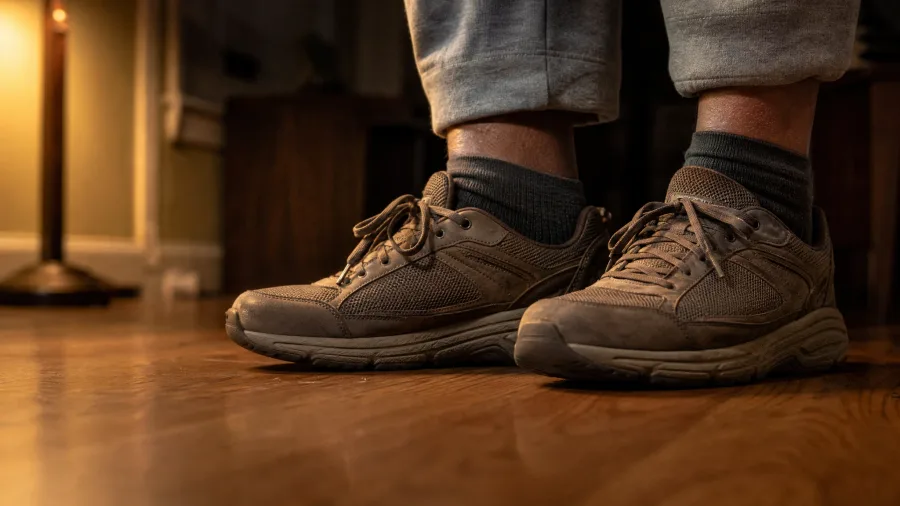
Your foundation dictates your entire skeletal stack, starting from the ground up.
Unsupportive flat shoes or excessive heel elevation alter your base of support, forcing your pelvis and spine to shift out of vertical alignment.
Ankle restriction travels upward, locking your knees and tipping your pelvis into a prematurely stiff gait.
Choose supportive footwear foundations, practice toe-spread exercises, and engage your foot arches consciously during daily walks.
Postural Strain Severity Spectrum
Measuring how daily habits impact your skeletal alignment over time
- Supportive Flat Footwear: Maintains natural base of support and neutral pelvic stack.
- Asymmetric Tote Carrying: Introduces persistent lateral spinal curvature and muscle strain.
- Continuous 45-Degree Texting: Doubles cervical load and rapidly accelerates upper back hunching.
Scale ranges from minimal structural impact to high compressive stress.
🔄 Daily Posture Reversal Sequence
Morning Alignment
Perform the 4-point wall test immediately upon waking to establish neutral stack.
Midday Ergonomics
Adjust your workspace screen to eye level and add a firm lumbar cushion.
Commute Reset
Set your car seat backrest to 100 degrees before starting your engine.
Evening Decompression
Practice 360-degree diaphragmatic breathing to open your collapsed chest.
Static Bracing vs. Dynamic Neuromuscular Retraining
Static Bracing
- Relies on external plastic or elastic support straps.
- Allows deep stabilizing muscles to weaken from disuse.
- Fails to change your default posture when removed.
- Creates artificial rigidity without functional strength.
Dynamic Retraining
- Engages your own core and spinal stabilizers actively.
- Re-educates the nervous system for lasting alignment.
- Builds functional strength that holds you upright naturally.
- Adapts seamlessly to any environment or seating setup.
The Clinical Consensus: Where Posture Meets Structural Longevity

Physical therapists consistently point to one fundamental truth about alignment.
Structural posture is never fixed by rigid plastic bracing. It requires dynamic neuromuscular re-education.
Reversing postural decay preserves your joint cartilage, prevents early osteoarthritis, and maintains your functional independence as you age.
Your nervous system possesses remarkable neuroplasticity, meaning you can learn a brand new default alignment at any chronological age.
The Wall Posture Audit — At a Glance
⏱️ Time Required
2 minutes
📅 Frequency
Once every morning
🎯 Key Contact Points
Head, shoulders, glutes, heels
⚠️ Common Flaw
Tucking chin too aggressively
💰 Cost
Free
Why It Matters
Provides an instant, objective baseline of your daily structural alignment.
Reclaiming Vertical Vitality: Your Daily Reset Protocol

Transforming your silhouette from a compressed gravity victim to a vertically aligned framework requires daily consistency.
Start your morning with the 4-point wall test, lift your screens, and eliminate asymmetric carrying habits.
Commit to this three-minute reset sequence every day, and watch your posture project the vibrant energy you actually feel inside.
Frequently Asked Questions
Can years of bad posture actually be reversed after age 50?
Yes, absolutely. Your nervous system retains neuroplasticity throughout life, allowing you to retrain deep stabilizing muscles and restore your natural vertical alignment with consistent daily practice.
Does poor posture cause facial sagging and wrinkles?
Yes. Chronic forward-head posture creates constant downward tension on your neck and jawline muscles, pulling facial tissues downward and altering your natural profile significantly.
How long does it take for a new posture habit to become automatic?
Most people notice improved baseline awareness within two to three weeks of consistent daily resets, while full neuromuscular habituation typically takes around sixty to ninety days.
Are standing desks a cure-all for slouching?
Not entirely. Standing desks prevent sitting fatigue, but people frequently slip into static slouching while standing, leaning heavily onto one hip and compressing their lower backs.
Is back pain always a symptom of poor posture?
While postural strain is a leading contributor to daily discomfort, back pain can stem from various clinical causes. Always consult your personal physician if pain persists or worsens.
Reclaiming Vertical Vitality: Your Daily Reset Protocol
You do not have to accept a compressed, aged silhouette as an inevitable part of getting older.
Start with a single change today, whether that means raising your phone or swapping your heavy tote for a balanced pack. Make it stick, stand tall, and own your space.

Meet Edward Green, the founder of GolfingGoal and a seasoned expert in golf. With years of experience on the course and a passion for the sport, Edward has a wealth of knowledge to share. As our Lead Writer, he contributes articles, tutorials, and resources to help readers to improve their skills and reach their full potential on the golf course. Join Our Team!