

You slide under the covers feeling thoroughly exhausted, drift off within minutes, and then your eyes snap wide open at 3:14 AM with your mind racing about tomorrow's schedule.
Sleep architecture changes naturally as we age, making our nightly rest much more vulnerable to everyday disruptions that we easily shook off at twenty-five.
Sleep medicine specialists consistently point out that midlife sleep loss is rarely random, usually stemming from specific, hidden behavioral habits before bed.
💡 PRO TIP
The Shift in Sleep Architecture
Deep slow-wave sleep naturally declines after forty-five. Protecting the hours you do get requires removing avoidable friction from your nightly routine.
Why the Rules of Rest Change After 45

Your biological clock operates differently today than it did decades ago.
Homeostatic sleep pressure, driven by the accumulation of adenosine in your brain throughout the day, builds up much more slowly as you age. At the same time, your circadian rhythm experiences a phase advance, pulling your internal clock forward and making your evening wind-down window narrower and far less forgiving.
When minor autonomic nervous system arousal occurs during the night, a less resilient midlife system struggles to return to deep rest quickly.
⏳ The Progression of Midlife Sleep Vulnerability
Adenosine Slowdown
Sleep pressure builds at a reduced rate during waking hours.
Phase Advance
Your internal biological clock shifts earlier, narrowing the evening wind-down window.
Autonomic Arousal
Minor physical or mental triggers easily disrupt lighter sleep stages.
Fragmented Rest
Awakenings become frequent between 2:00 AM and 4:00 AM.
The Late-Evening Digital Habit That Keeps Your Brain Alert

Reaching for your phone to check email or scroll through feeds right before sleep is a primary disruptor.
Blue-spectrum light emitted from screens suppresses melatonin secretion, but the cognitive activation from scrolling keeps your amygdala hyper-vigilant. Older eyes transmit more short-wavelength light directly to the suprachiasmatic nucleus, magnifying this hormonal delay.
You need a strict sixty-minute digital sunset that removes both the light and the mental stimulation from your bedroom entirely.
Passive Reading vs. Phone Scrolling Before Sleep
Phone Scrolling
- Triggers active dopamine responses
- Exposes eyes to intense blue-spectrum light
- Keeps heart rate variability suppressed
- Invites stressful news and notifications
Physical Book Reading
- Encourages natural mental decompression
- Uses warm, indirect lamp illumination
- Allows heart rate to settle into rest mode
- Signals clear transition to sleep
Treating Alcohol as a Sedative Nightcap

A glass of wine feels relaxing on the couch, but it acts as a chemical trap for midlife sleep.
While alcohol helps induce initial sleep onset by boosting GABA activity, it violently fragments the second half of the night through rebound excitation. Liver metabolism slows significantly after forty-five, prolonging the clearance of acetaldehyde and worsening nocturnal vasodilation and hot flashes.
Sleep specialists emphasize that evening alcohol suppresses restorative REM sleep and triggers upper airway resistance.
⚠️ COMMON MISTAKE
The Alcohol Rebound Effect
Using wine to unwind guarantees a 3:00 AM adrenaline surge as your liver processes the alcohol, destroying the quality of your second half of the night.
Shifting Sleep Timelines Heavily on Weekends
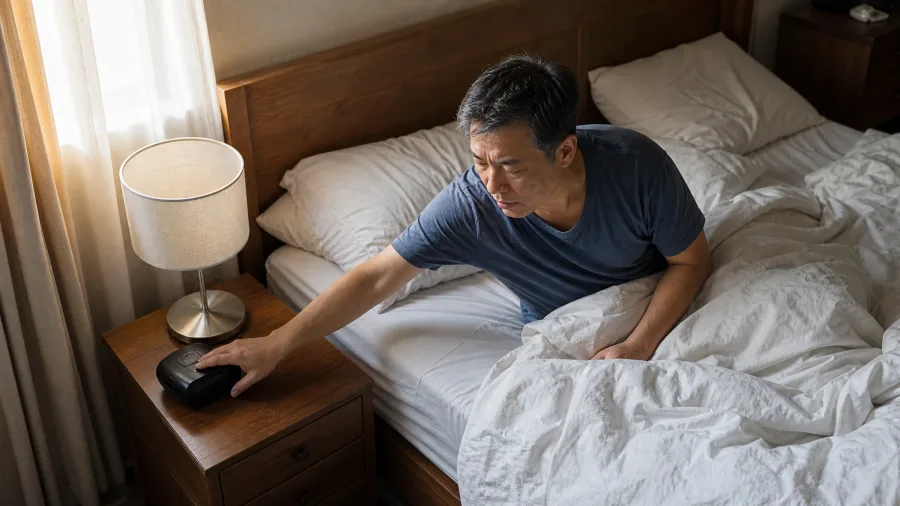
Sleeping in for two extra hours on Saturday and Sunday feels restorative, but it creates internal confusion.
This habit, known as social jetlag, shifts your wake time and destabilizes your internal biological clock. Midlife bodies tolerate schedule drift poorly compared to younger years due to a rigidifying circadian pacemaker that requires consistent anchor points.
Protect your morning cortisol alignment by anchoring your wake-up time within a tight thirty-minute window seven days a week.
Social Jetlag — At a Glance
⏰ Schedule Drift
More than 60 minutes on weekends
🧠 Impact
Destabilizes circadian pacemaker
⚡ Result
Monday morning severe fatigue
🛡️ The Fix
Anchor wake time daily
Core Mechanism
Consistent morning light exposure locks your internal biological clock in place.
Staring at the Clock During Night Awakenings
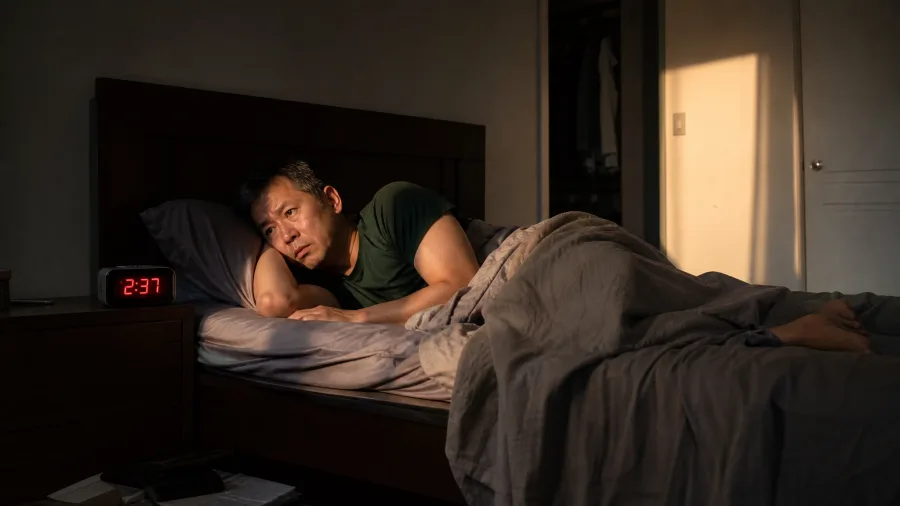
Waking up in the dark and immediately looking at the glowing numbers on your alarm clock starts a harmful mental loop.
Checking the time triggers catastrophic math regarding how many hours of rest remain, causing an immediate spike in cortisol and adrenaline. This hormonal surge raises your core body temperature and locks your nervous system into extended wakefulness.
Turn all bedroom clocks away from your bed and practice the twenty-minute rule by moving to a comfortable chair with dim light if sleep does not return.
Best Strategies for Night Waking
Separating Structural Realities from Reversible Triggers

Even with pristine habits, hormonal shifts during midlife create a baseline level of sleep friction.
Recognizing this reality helps you avoid unnecessary frustration when your body experiences normal fluctuations. Eliminating the major behavioral habits removes the compounding factors that turn minor nocturnal awakenings into hours of frustrating insomnia.
Shift your focus from forcing rigid perfection to building reliable biological resilience through daily consistency.
Midlife Sleep Metrics
Key physiological markers after age 45
Derived from clinical sleep medicine observations.
The Routine Transformation
Disruption Severity Spectrum
Ranking habits by their disruption level on sleep architecture
- Reading Before Bed: Minimal disruption; supports natural relaxation.
- Weekend Sleep-In: Moderate disruption; causes mild social jetlag.
- Nightcap Alcohol: High disruption; fragments second half of night.
- Late Phone Scrolling: Severe disruption; blocks melatonin and spikes alertness.
Bedtime Habit Traffic Lanes
- 📖 Physical book under warm light — Safe to practice every single night.
- ⏰ Waking up 90 minutes late on weekends — Use caution; limit schedule drift to 30 minutes.
- 📱 Checking social media feeds in bed — Stop immediately; creates severe sleep anxiety.
Follow these lanes to stabilize your nightly rhythm.
Frequently Asked Questions
Is it normal to need less sleep after turning 45?
Total daily sleep requirements remain between seven and nine hours for optimal health. However, the ability to consolidate that sleep into a single block declines naturally, requiring more intentional evening habits.
Do magnesium supplements actually fix middle-of-the-night waking?
Magnesium glycinate supports mild neuromuscular relaxation and eases nervous system tension. While helpful for some adults, it does not replace the need to eliminate behavioral disruptors like late screen time.
How long does it take to reset sleep architecture after dropping bad habits?
Circadian rhythms and sleep pressure systems typically require two to three weeks of consistent scheduling and boundary-setting to show measurable improvements in night-to-night continuity.
Are afternoon naps safe for people over 45?
Short power naps lasting under twenty minutes taken before mid-afternoon provide cognitive refreshment without hurting nighttime sleep pressure. Longer naps severely compromise your ability to fall asleep at night.
What is the single most important habit change to start tonight?
Establish a strict digital sunset by moving all smartphones and tablets out of the bedroom sixty minutes before you plan to sleep. This single boundary protects both melatonin production and mental calm.
Your First Step Toward Better Rest
Improving sleep after forty-five is not about forcing rigid perfection or adhering to impossible schedules. It comes down to removing the specific friction points that trigger middle-of-the-night awakenings.
Pick just one habit to adjust starting tonight, give your nervous system two weeks to adapt, and notice how steady your mornings become.

Meet Edward Green, the founder of GolfingGoal and a seasoned expert in golf. With years of experience on the course and a passion for the sport, Edward has a wealth of knowledge to share. As our Lead Writer, he contributes articles, tutorials, and resources to help readers to improve their skills and reach their full potential on the golf course. Join Our Team!