
You swing your legs over the edge of the mattress at 7:00 AM and your lower back feels like dry concrete.
Your knees make a faint grinding noise on the walk to the kitchen. You wait for the hot shower or the first cup of coffee to loosen things up, assuming this heavy, creaky feeling is just the non-negotiable tax of turning 55. But physical therapists do not wait for coffee to start moving.
They know that overnight stiffness is not permanent structural damage. It is a predictable biological shift in your joint fluid and fascia that responds instantly to targeted motion.
By spending seven deliberate minutes on five strategic movements before leaving the bedroom, clinicians actively flush out overnight joint gelation. You do not need an hour of intense yoga or aggressive gymnastics to regain your morning baseline range of motion.
Why 'Morning Gelation' Changes After 55

Your joint fluid physically thickens while you sleep.
This phenomenon is known clinically as morning gelation. As we age, cartilage imbibition—the process where joints absorb protective nutrients during movement—slows down significantly during extended periods of stillness.
When you lie motionless for eight hours, synovial fluid transforms from a slick, free-flowing lubricant into a thick, gelatinous matrix. Meanwhile, your fascia loses temperature and pliable elasticity. Forcing your body directly into upright, load-bearing walking while cold triggers a protective guarding response from your nervous system.
That guarding is the stiffness you feel.
Physical therapists avoid cold static stretching because pulling hard on un-warmed collagen fibers causes muscle spindles to contract defensively. The goal first thing in the morning is low-load, dynamic joint mobilization—gentle pumping motions that raise local tissue temperature by half a degree and force fresh fluid into the joint capsule before your feet hit the floor.
⚠️ COMMON MISTAKE
The Cold Tissue Rule
Never force a deep static stretch on un-warmed morning fascia. Yanking on cold hamstring or lower back tissues triggers protective spindle firing, making muscles clamp down tighter. Always begin with gentle, dynamic movement loops to warm the joint fluid first.
The Morning Mobility Impact
How targeted movement changes joint physiology after 55
1. The Quadruped Cat-Cow to Child's Pose Flow
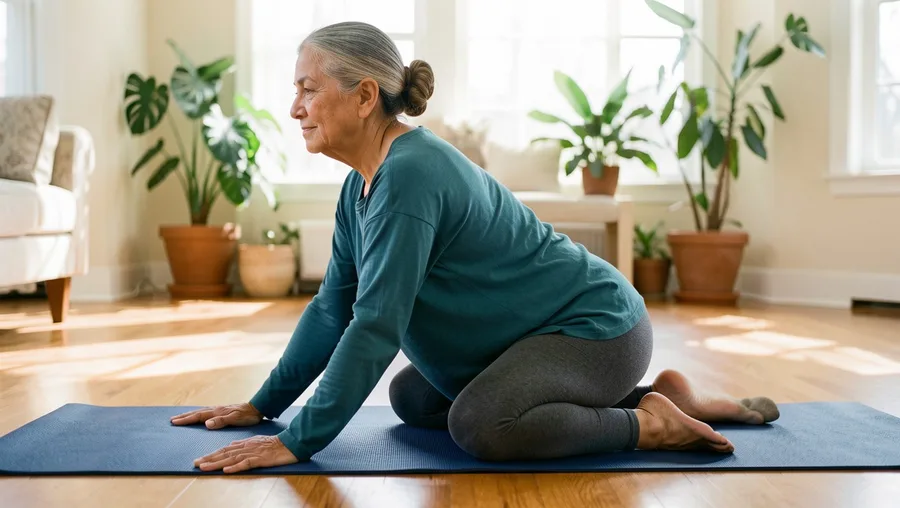
Your spine needs link-by-link fluid exchange before taking on gravity.
This dynamic movement targets the thoracic and lumbar spine, gently opening compressed intervertebral discs without pushing into painful terminal ranges. By cycling between gentle spinal flexion, extension, and deep hip flexion, you systematically pump fluid across every spinal segment.
Start on all fours with wrists directly under shoulders and knees under hips. Inhale as you drop your belly slightly, lifting your heart and tailbone into a mild Cow pose; exhale as you round your spine toward the ceiling into Cat. After four fluid cycles, widen your knees, send your hips back toward your heels, and slide your arms forward into Child's Pose for two slow breaths.
Perform 8 to 10 slow, continuous cycles, matching every movement to a long, steady breath.
If carpet or hardwood hurts your knees, place a folded bath towel beneath your shin bones or perform a modified seated version on the edge of your bed.
💡 Tip: Never force your lower back to arch aggressively during Cow. Keep the extension focused between your shoulder blades.
Best For
2. The Bed-Edge Knee-to-Chest Lumbar Opening
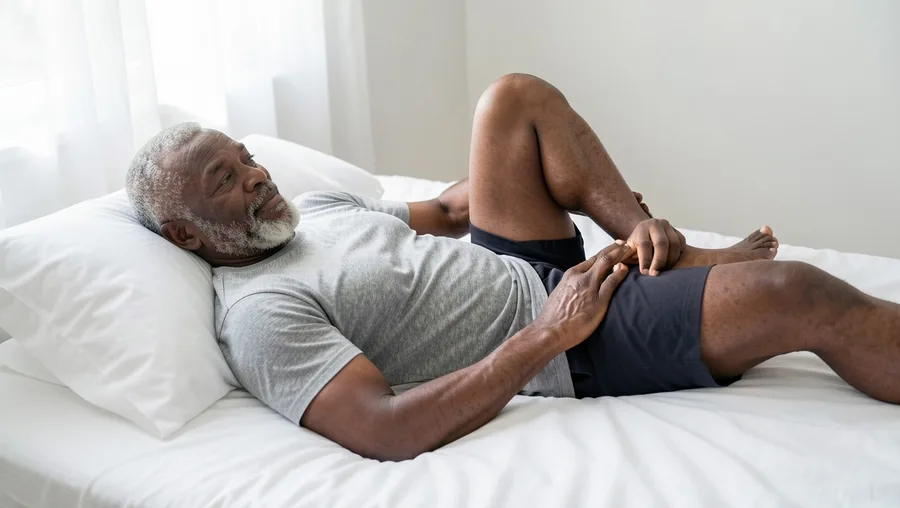
Decompress your lower back while still lying flat in bed.
This supine position eliminates gravity's axial load entirely, making it ideal for relieving lower back tightness accumulated from awkward sleeping angles. Drawing one knee to your chest flattens the lumbar arch safely while letting the opposite leg hang or extend opens up tighter hip flexors.
Lie on your back near the edge of your mattress. Draw your right knee gently toward your chest with both hands, clasping behind the thigh rather than over the kneecap. Keep your left leg relaxed, letting gravity pull the thigh flat against the mattress or slightly over the edge.
Hold this mild stretch for 20 to 30 seconds while taking three deep diaphragmatic breaths, then switch sides.
Avoid cranking your knee with maximum upper-body force. You want a gentle length across your lower back and glutes, not a shoulder workout.
💡 Tip: Clasp your hands around your hamstrings, not your shin bone, if you have history of meniscus tears or knee replacement.
Knee-to-Chest Form Check
3. The Standing Overhead Supination & Ribcage Expansion
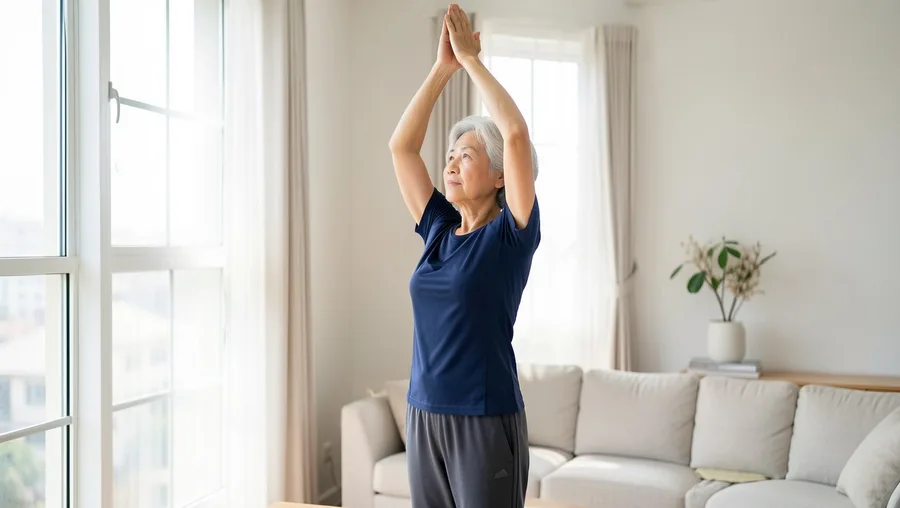
Undo eight hours of slouching and side-sleeping collapse.
Side sleeping and thick pillows push your chest into a rounded, kyphotic position for hours. This standing reach resets your thoracic spine into extension, stretches compressed intercostal breathing muscles, and opens up restricted shoulder capsules before you start your day.
Stand tall with feet hip-width apart near a window. Interlace your fingers, rotate your palms toward the ceiling, and press upward as you take a deep, full inhalation directly into your ribs. Reach slightly to the left on an exhale, return to center, and gently lean to the right.
Complete 3 slow lateral reaches per side, inhaling at the peak of each overhead stretch.
If you suffer from shoulder impingement or rotators cuff stiffness, keep your palms facing inward toward each other at a 45-degree angle rather than locking fingers overhead.
💡 Tip: Keep your glutes lightly squeezed during the reach to prevent arching your lower back instead of your thoracic spine.
Overhead Reach — At a Glance
⏱️ Time
60 seconds
🎯 Targets
Ribcage, thoracic spine, lats
🫁 Breathing
Deep lateral expansion
⚠️ Modify If
Shoulder pain exists — widen grip
Key Benefit
Instantly opens breathing capacity and counters forward-head posture.
4. The Doorway Anterior Chain Reset
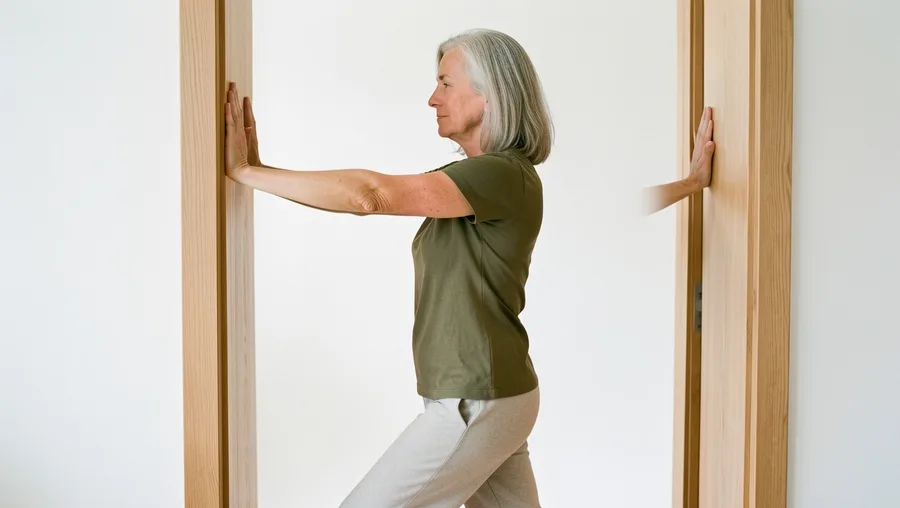
Your chest muscles tighten rapidly when sleeping or sitting.
A tight pectoralis minor pulls your shoulder blades forward and down, locking your neck into an uncomfortable forward posture. Physical therapists use doorway stretches because the rigid frame provides controlled leverage without stressing the delicate shoulder joint.
Stand in an open doorway with one foot stepped forward in a soft staggered stance. Place your forearms flat against the door frame at a 90-degree angle so your elbows sit slightly below shoulder height. Lean your torso forward gently until you feel a comfortable stretch across your chest and shoulders.
Hold this position for 20 to 30 seconds while maintaining a tall, upright spine and relaxed neck.
Do not let your head poke forward like a turtle to get further into the doorway. Keep your chin tucked gently and let the stretch rest entirely on the chest muscles.
💡 PRO TIP
Protect the Lower Back
Keep a light tuck in your tailbone while stepping forward in the doorway. If you arch your lower back to force a deeper chest stretch, you transfer unwanted pressure directly onto your lumbar spine.
5. The Wall-Supported Ankle & Gastrocnemius Rocker
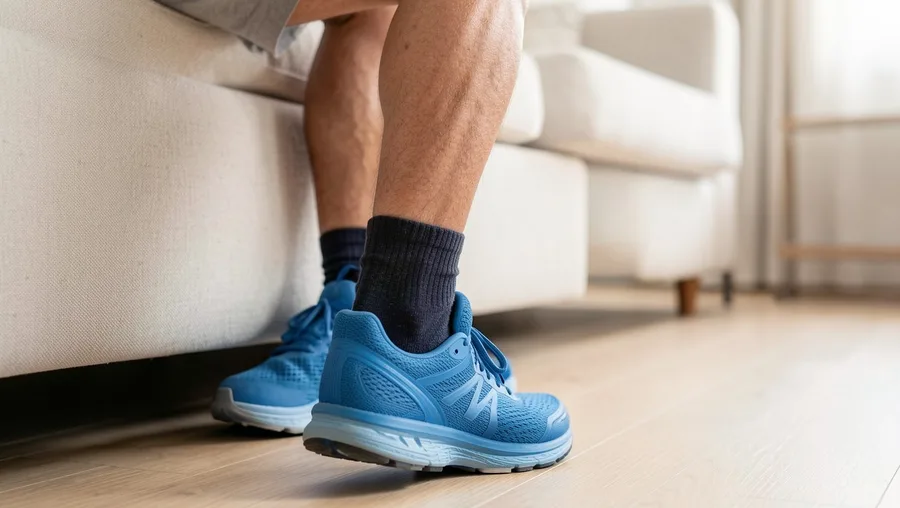
Stiff ankles are the primary hidden cause of morning balance loss.
After 55, tight Achilles tendons and gastrocnemius muscles reduce your ankle dorsiflexion. When your ankle cannot bend forward smoothly, your body compensates by shortening your stride, increasing your risk of tripping on rugs or threshold lips.
Stand facing a wall at arm's length and place both palms flat against it at shoulder height. Step your left leg back about two feet, keeping the heel pressed firmly into the floor and the back knee straight. Gently bend your front right knee to push your hips toward the wall until you feel a deep stretch in your back calf.
Hold for 20 seconds, then slightly bend your back knee while keeping your heel grounded to target the deeper soleus muscle.
Perform this two-part sequence twice on each leg before putting on your shoes for the day.
Morning Routine Time Budget
The Golden Rules: What Every Orthopedic Specialist Agrees On
Consistency always beats intensity when remodeling aging connective tissue.
Orthopedic specialists and physical therapists consistently emphasize three core rules when designing home mobility programs for adults over 55. If you push into sharp pain, your nervous system responds with reflex muscle contraction, completely defeating the purpose of the stretch.
Stay at a 3 or 4 out of 10 on the discomfort intensity scale.
Exhale slowly into the point of tightness rather than holding your breath. Deep breathing activates your parasympathetic nervous system, signaling target muscles to yield and release baseline tone.
Doing this seven-minute sequence every morning will do more for your joint longevity than a single two-hour stretching session on Sunday afternoon.
⏱️ The 7-Minute Flow Order
Bed & Mat Reset
Perform Cat-Cow and Knee-to-Chest pulls while tissue is warming up.
Standing Posture Openers
Transition upright for Overhead Reaches and the Doorway Chest stretch.
Ground Anchor
Finish at the wall with Ankle Rockers to prime your gait for walking.
The 10-Second Morning Mobility Diagnostic
Test your functional range of motion before stepping into your daily routine.
Physical therapists frequently use quick functional checkpoints to measure baseline readiness and catch subtle mobility losses before they turn into nagging injuries.
Sit on the edge of a firm dining chair with your feet flat on the floor, cross your arms over your chest, and stand up without leaning forward aggressively or using momentum. If your knees cave inward or you feel an intense pull in your lower back, your hips and ankle dorsiflexors need extra attention.
Spend an extra 30 seconds on Stretch 5 whenever this test feels sluggish.
Your First Week Plan
Frequently Asked Questions
Should I do these morning stretches before or after my coffee?
Perform them before sitting down for coffee. Moving while your body is transitioning from sleep prevents extended sitting from reinforcing morning stiffness.
Is it safe to crack or pop during these stretches?
Painless joint clicking or popping is usually harmless gas release from joint capsules. However, if popping is accompanied by sharp, sudden pain, stop immediately and seek medical evaluation.
Can I perform these if I have mild sciatica or spinal stenosis?
Yes, but keep spinal extension gentle. Focus on neutral alignments during Cat-Cow and avoid pulling knees excessively tight if neural pain radiates down your leg.
How long will it take to notice a lasting difference in my stiffness?
Synovial fluid responds immediately, giving you short-term relief within minutes. Long-term structural changes in tight fascia take 4 to 6 weeks of daily repetition.
Make It Your First Habit Tomorrow
Anchor your new routine to an existing daily trigger.
Tie Stretch 1 directly to the act of swinging your legs out from under the covers tomorrow morning. Do not overthink the form or worry about perfect flexibility on day one.
Movement is lotion for aging joints, and seven simple minutes is all it takes to keep your body moving freely through the years ahead.

Meet Edward Green, the founder of GolfingGoal and a seasoned expert in golf. With years of experience on the course and a passion for the sport, Edward has a wealth of knowledge to share. As our Lead Writer, he contributes articles, tutorials, and resources to help readers to improve their skills and reach their full potential on the golf course. Join Our Team!