

You alarm goes off at 5:30 AM, you lace up your running shoes, and you log a punishing forty-minute sweat session before the rest of the house wakes up. You feel accomplished, energized, and entirely protected against the physical toll of modern life.
Then you sit down at your desk for nine straight hours.
That morning workout felt like a free pass, but physiology does not work on a loyalty program. Unbroken hours of chair time silently undo the metabolic gains of your morning exercise, locking your body into a state of cellular inactivity that sweat alone cannot fix.
⚠️ COMMON MISTAKE
The Exercise Halo Trap
Many people assume an hour of morning movement neutralizes eight hours of stillness. Biologically, it does not. Exercise and sedentary behavior operate on entirely separate physiological tracks.
The Paradox of the Dedicated Mover

Exercise physiologists have coined a frustrating term for people who train hard yet remain immobile all day: the Active Couch Potato.
You hit every weekly cardiovascular target, you lift weights three times a week, and your wearable device praises your step count. Yet, beneath that athletic veneer, your body reacts to prolonged chair time as if you did not exercise at all.
Voluntary skeletal muscle exertion during a morning workout burns calories and strengthens muscle fibers, but it cannot override the systemic physiological suppression caused by consecutive hours of sitting.
Your metabolism requires frequent mechanical stimulation throughout the entire waking day, not just a single intense burst followed by absolute stillness.
The Cost of Unbroken Sitting
What happens beneath the surface during long desk sessions
The Cellular Freeze: What Happens When Muscles Go Silent

Your legs are built to carry you, not to anchor you to an ergonomic chair for forty hours a week.
When your lower-limb skeletal muscles stop contracting, a critical enzyme called lipoprotein lipase goes to sleep. This enzyme acts as a molecular vacuum cleaner, clearing triglycerides and fats directly out of your bloodstream.
Continuous sitting halts this enzyme production almost entirely. The moment you sit down, your body's ability to clear circulating fats plummets by up to ninety percent, leaving those lipids to circulate and accumulate.
Meanwhile, your postural soleus muscles—the hardworking calf muscles designed to maintain posture with minimal effort—shut down completely. Without their slow-twitch electrical firing, localized glucose uptake drops, and your cellular fuel management stalls out.
Cellular Facts Every Mover Should Know
The Vascular Toll: Stiffening Arteries and Sluggish Flow

Circulation requires friction.
As blood pulses through your arteries, it generates a physical force against the inner lining known as shear stress. This friction stimulates endothelial cells to release nitric oxide, a natural gas that keeps your blood vessels elastic, flexible, and wide.
When you sit continuously, your legs remain lower than your heart, gravity pulls blood downward, and the lack of muscular contractions reduces blood velocity. Shear stress drops, nitric oxide production slows down, and your arteries begin to lose their youthful compliance.
This localized vascular sluggishness does not vanish just because you ran three miles at dawn. The endothelium in your lower limbs records every single hour you spend immobile, gradually increasing arterial stiffness over time.
Vascular Health: Continuous Sitting vs. Active Movement
Continuous Sitting
- Reduced blood flow velocity in lower limbs
- Low shear stress on arterial walls
- Impaired nitric oxide production
- Progressive lower-limb vascular stiffness
Interrupted Sitting
- Maintains healthy venous return
- Consistent shear stress triggers nitric oxide
- Preserves arterial compliance
- Keeps lower-extremity microcirculation active
Metabolic Stagnation: Insulin, Glucose, and the Postprandial Spike

Your lunch break tells a quiet, hidden story about your metabolic health.
When you eat a midday meal while remaining completely sedentary, your body processes the incoming glucose and fats sluggishly. Without contracting muscles to act as glucose sinks, your cells pull sugar out of the bloodstream much less efficiently.
The result is a sharp, exaggerated postprandial blood sugar and lipid spike that lingers much longer than it would if you interrupted your afternoon with brief walks.
Your morning workout improved your insulin sensitivity for roughly twenty-four hours, but that systemic benefit cannot completely counteract the acute, localized insulin resistance induced by sitting uninterrupted through lunch and dinner.
Metabolic Risk Spectrum by Unbroken Sitting Duration
How risk accumulates across an unmanaged workday
- 30 Minutes: Minimal impact; normal cellular function and steady enzyme levels.
- 90 Minutes: LPL enzyme activity drops significantly; circulation slows in calves.
- 3 Hours: Endothelial function impaired; insulin sensitivity visibly blunted.
- 6+ Hours: Maximal cellular stagnation; sharp blood lipid and glucose spikes after eating.
The Turning Point: Why Exercise Is Not an Antidote

We must change how we think about fitness.
Exercise and sedentary behavior are not two opposite ends of a single linear scale. They are two entirely separate axes of human health that influence different biological systems.
You can possess a strong heart, dense bones, and powerful muscles from your gym routine while simultaneously suffering from the chronic vascular and metabolic friction of a sedentary lifestyle.
Structured exercise builds your physical capacity, but movement frequency protects your baseline biology. You need both to thrive as you age.
💡 PRO TIP
The Two-Axis Framework
Treat your morning workout as your structural insurance policy, and your daytime movement breaks as your daily operating system. One does not replace the other.
The Movement Self-Check: Are You an Active Couch Potato?

Take an honest look at how your actual hours unfold between waking up and winding down.
If you log an hour at the gym but follow it with a seated breakfast, a seated car commute, a seated desk job, a seated lunch, a seated evening commute, and a seated evening television session, your daily movement profile is heavily skewed toward stillness.
Cellular downregulation begins setting in remarkably fast—often after just thirty to forty-five minutes of unbroken posture. If your calendar leaves you trapped in chairs for hours on end, your body is paying a metabolic tax.
Recognizing this hidden trap is the first step toward reclaiming the full health benefits of the work you already put into your fitness routine.
Time and Effort Budget for Movement Breaks
Sedentary Risk Profile — At a Glance
⏱️ Threshold
30 to 45 minutes of stillness
📉 Enzyme Loss
Up to 90% LPL reduction
🩸 Primary Impact
Blunted postprandial glucose control
🛡️ The Solution
Frequency over single-bout intensity
Core Takeaway
Your metabolism demands frequent muscle contractions throughout the entire waking day.
Strategic Interventions: Breaking the Habit Without Breaking Your Workflow
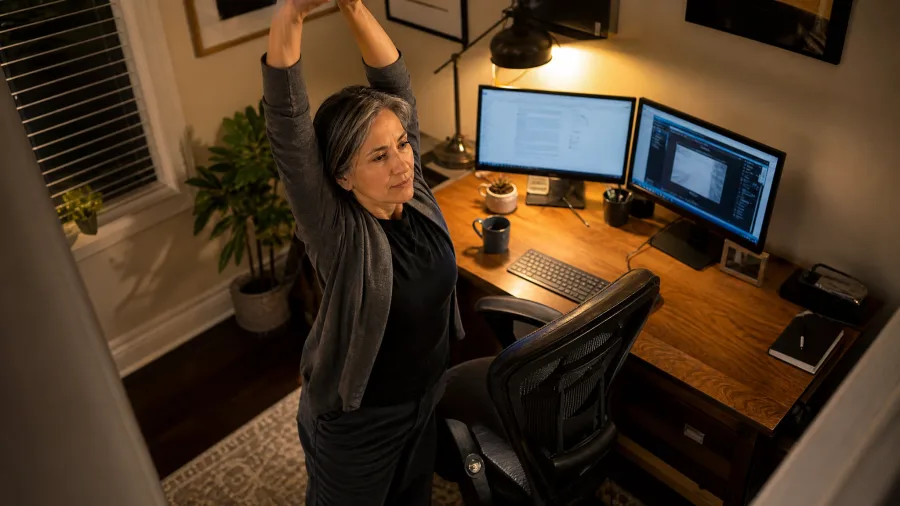
You do not need to abandon your desk job or buy an expensive treadmill workstation to protect your vascular health.
Adopt the rule of frequency over intensity by setting a gentle timer on your phone or computer to remind yourself to stand up every forty minutes.
When the timer goes off, spend two minutes walking to the kitchen, doing ten bodyweight calf raises to activate your soleus muscles, or simply standing while taking a phone call.
Restructuring your day with these low-profile micro-movements restarts your lipoprotein lipase enzymes, clears glucose from your bloodstream, and preserves your circulation without disrupting your deep work.
🔄 The Hourly Movement Protocol
The 40-Minute Mark
Your timer rings to signal the onset of cellular and enzyme slowdown.
The Upward Transition
Stand up immediately, engaging your glutes and core to reset posture.
The Soleus Activation
Perform ten seated or standing heel raises to stimulate lower-limb blood flow.
The Short Walk
Take a brief 120-second walk down the hallway before returning to your tasks.
Best Strategies For Busy Professionals
Movement Habit Traffic Light
- The Morning Workout — Keep your gym routine; it builds vital strength and cardiac capacity.
- Standing Desks Exclusively — Standing still all day replaces sitting stillness with standing fatigue; add motion.
- Unbroken 3-Hour Blocks — Eliminate long periods of absolute stillness during work hours.
Frequently Asked Questions
Can a standing desk completely eliminate the risks of the sitting habit?
Not entirely on its own. While standing burns slightly more energy than sitting, standing completely still for hours still leads to lower-limb blood pooling and muscle inactivity. Movement and posture variation are what truly protect your metabolic health.
How long does it take for metabolic suppression to begin once you sit down?
Cellular changes begin within thirty to forty-minues of continuous stillness. Local enzyme activity drops sharply during the first hour, making regular micro-breaks essential throughout your workday.
Does high-intensity interval training protect against vascular damage better than steady cardio?
Both forms of exercise build cardiovascular fitness and improve systemic health, but neither form of single-bout exercise fully reverses the localized endothelial dysfunction caused by subsequent hours of unbroken sedentary time.
What is the minimum amount of movement required to restart lipoprotein lipase activity?
Even light muscular contractions, such as walking at a casual pace or performing simple calf raises for one to two minutes every hour, are enough to wake up dormant enzymes and restore local blood flow.
Can evening workouts compensate for a day at a desk if my total steps exceed 10,000?
High step counts help, but if those steps are lumped into a single morning or evening walk while the rest of the day is spent motionless, your body still registers the physiological impact of prolonged uninterrupted sitting.
Reclaim Your Baseline: The Power of the Interrupted Day
Your morning gym session is not wasted, but it was never designed to carry the burden of an entirely motionless day. True health lives in the balance between dedicated training and consistent, gentle movement.
Protect your workout, but guard your hours between them. Stand up, break the cycle of stillness, and give your metabolism the continuous rhythm it was built to run on.

Meet Edward Green, the founder of GolfingGoal and a seasoned expert in golf. With years of experience on the course and a passion for the sport, Edward has a wealth of knowledge to share. As our Lead Writer, he contributes articles, tutorials, and resources to help readers to improve their skills and reach their full potential on the golf course. Join Our Team!