

You squeeze past three taped cartons of 1980s appliance manuals and a tower of rinsed plastic tubs just to reach the kitchen sink.
It is easy to mistake this refusal to discard broken machinery and decades of receipts for stubborn defiance or mere eccentricity. Yet late-life extreme accumulation is driven by measurable declines in prefrontal executive function, visual habituation, and an involuntary psychological defense against shrinking independence.
Understanding these underlying shifts changes your objective. Managing the home is no longer about winning an exhausting debate over old paper, but identifying the cognitive strain at work so you can eliminate urgent physical hazards without provoking defensive resistance.
Saving Behaviors At A Glance
Objects Serve as External Memory Banks When Recall Fades

Physical possessions become external storage units when internal episodic recall begins to fade. Tangible items provide the concrete cues needed to reconstruct past events and identities.
A dented toolbox, yellowed correspondence, and out-of-date work clothes function as direct physical stand-ins for deceased partners, former careers, and younger identities. Touching the worn handle or reading familiar handwriting retrieves specific moments that the brain can no longer generate spontaneously, anchoring a drifting sense of self to solid matter.
Discarding the object feels like destroying the memory itself.
That perception turns basic housecleaning into an act of personal betrayal, producing sharp distress that looks to an outsider like unreasonable stubbornness over broken junk.
Sentimental keeping usually protects a curated drawer of genuine mementos, but severe saving often crosses into personifying everyday refuse. When someone begins attributing feelings and vulnerability to discarded packaging, throwing away a stained cardboard box feels less like tidying up and more like inflicting harm on something defenseless.
💡 PRO TIP
Preserve the Memory, Not the Mass
Photograph meaningful items and assemble them into a flat spiral-bound book. Older adults often part with physical clutter when they are confident the visual cue remains accessible.
Scarcity Conditioning Makes Discarding Feel Morally Reckless

Even without emotional attachment, discarding everyday objects can feel like a direct violation of deeply ingrained moral standards. Early experiences with scarcity teach people that every manufactured item holds permanent, undeniable utility.
Decades of living through resource shortages create an automatic reflex that resists modern disposable culture. Rinsing and stacking hundreds of plastic margarine tubs, saving bent nails, or storing short lengths of electrical wire feels like responsible stewardship, whereas tossing them into a trash bin registers internally as reckless, shameful waste.
Anticipatory regret freezes the decision to let anything go.
The moment an item hovers over the bin, an acute wave of panic hits, driven by the absolute certainty that the object will be desperately needed tomorrow. Handing someone a replacement cost sheet does nothing to ease that tension, because the resistance is not an arithmetic calculation about household finances.
Explaining that a new bucket costs four dollars misses the point entirely. The habit is anchored in a lifetime of moral identity where preserving raw materials proves personal decency, discipline, and foresight.
The Hidden Costs of Clutter In Older Homes
Accumulation Compensates for Compounding Late-Life Loss

The anger that erupts over cleaning up is rarely about the objects themselves; it is a defensive stand for shrinking personal agency. Every surrendered item feels like another loss of control.
As retirement, the death of peers, lost driving privileges, and failing health strip away independence, the physical household becomes the final territory someone can still command. Controlling what stays and what goes serves as an essential psychological shield against the terrifying sensation that the rest of life is slipping away unchecked.
Black trash bags look like an eviction notice for identity.
When family members arrive with donation boxes, the person does not see helpful decluttering; they experience an aggressive, premature liquidation of their remaining existence while they are still sitting in the room. That perceived violation triggers fight-or-flight defenses, turning a well-intentioned cleanup into an agonizing power struggle over dignity.
When reduced physical mobility narrows someone's world to a single recliner, having stacks of belongings within immediate arm's reach creates a necessary sense of security, function, and containment against a shrinking horizon.
Harm Reduction Priorities — At a Glance
🚪 Exit Clearance
36-Inch Paths
🔥 Fire Safety
Clear Stovetop
🚿 Sanitation
Usable Shower
💊 Medication
Accessible Table
Core Rule
Target physical safety zones first and leave closed closets for later.
Declining Executive Function Paralyzes Sorting and Categorization

Sifting through a single disorganized box requires intense cognitive coordination that aging neural networks struggle to sustain as prefrontal gray matter thins and processing speed slows.
Working memory and sequencing erode early, disrupting the five-stage loop required to clear any surface: identifying an item, judging its utility, picking a category, choosing to keep or toss, and moving it. When mild cognitive impairment narrows executive bandwidth, weighing those competing priorities becomes an insurmountable cognitive block.
Mental exhaustion sets in within fifteen minutes.
After ten or fifteen minutes of rapid evaluation, cognitive fatigue produces acute irritability, confusion, and total task avoidance. The person stops not out of defiance, but because their brain cannot sequence another decision, leaving the half-sorted pile sitting indefinitely where it was dropped.
An afternoon of decluttering is not physical labor; it is a punishing, sustained test of executive function that an impaired brain cannot pass.
🔄 The Five-Step Executive Sorting Breakdown
Evaluation
The individual inspects an item to determine what it is and remember where it came from.
Utility Projection
Working memory tries to weigh whether the object could be useful in future scenarios.
Categorization
The brain struggles to assign the object to a specific storage or disposal group.
Decision Block
Cognitive overload produces acute anxiety, freezing the ability to choose an outcome.
Task Abandonment
The person returns the item to its original pile to relieve the mental strain.
Visual Overload Masks Environmental Risk
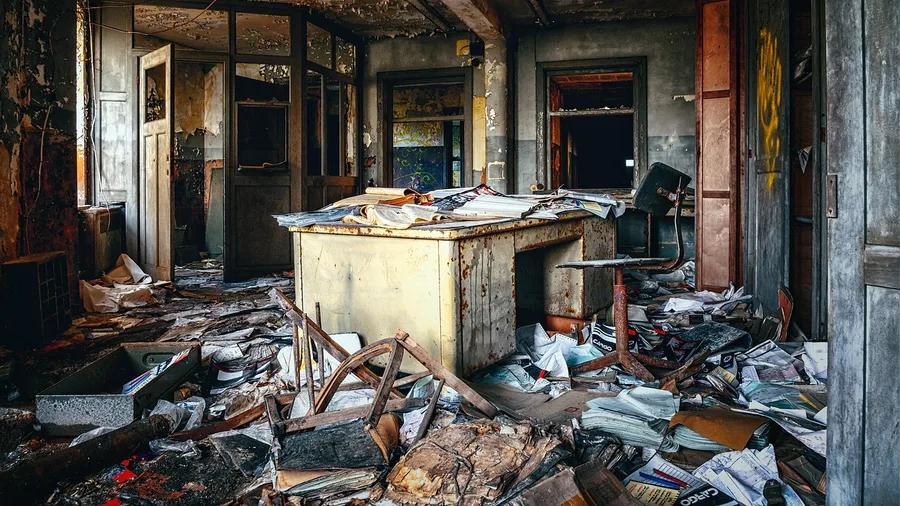
The occupant stops seeing the mess because the brain actively filters static surroundings through sensory habituation, turning chaotic rooms into invisible background wallpaper.
This clutter blindness creates a massive rift between external reality and internal perception. A visitor sees blocked exterior exits, unstable towers of magazines, and dangerous fall traps, while the resident experiences only a comforting, predictable cocoon of familiar shapes that has surrounded them for years.
Normal vision changes make the physical danger worse.
Age-related drops in contrast sensitivity, depth perception, and visual acuity make it genuinely hard to distinguish a tangled cord or floor-level drop from the carpet beneath it. The resident literally cannot see the hazard, yet they rely on those exact stacks of belongings as physical landmarks to find their way through low-contrast rooms.
Moving a pile disorients their internal spatial map, prompting immediate anxiety and an insistence that every item remain precisely where it has always been.
Late-Onset Hoarding Disorder Differs From Habitual Clutter

Extreme saving crosses from lifelong messiness into a clinical condition the moment living spaces lose their basic functions and discarding an object triggers severe panic.
Generational clutter might fill closets or garage shelves, but clinical hoarding renders kitchens unusable, blocks doorways, and assigns intense, abnormal emotional weight to discarded items. This neurobehavioral syndrome involves distinct information-processing deficits that make the prospect of throwing away a broken container feel like genuine peril.
Logical arguments cannot reason someone out of a pathology.
Traditional organizing systems collapse immediately because the resident is not dealing with poor habits, but an involuntary psychiatric response. When severe accumulation begins suddenly in late life without any prior saving history, it often points to neurological events like frontotemporal dementia, an undetected stroke, or an intracranial lesion.
An abrupt shift in household accumulation demands a medical evaluation and cognitive screening rather than another weekend spent trying to organize the hallway.
Distinguishing Clutter From Clinical Hoarding
Generational Clutter
- Living areas retain primary functions for cooking and sleeping
- Open to donating items if someone else handles the hauling
- Clutter is concentrated in attics, basements, and garages
- Experiences mild annoyance rather than panic when items leave
Clinical Hoarding
- Stoves, sinks, beds, and showers cannot be safely accessed
- Severe distress, anger, or panic at the thought of disposal
- Narrow goat paths connect rooms through packed spaces
- Refusal to let repair workers or family enter the home
Sunk-Cost Fallacies Amplify Anxiety Over Waste

An older adult often weighs what an item cost in 1974 against its present zero utility, treating the act of disposal as an immediate, painful financial loss.
Holding onto twenty-four volumes of outdated encyclopedias or a heavy oak hutch gets justified by an imagined future windfall. They convince themselves an antique dealer will pay top dollar or a grandchild will furnish an entire apartment with it, which conveniently postpones the agonizing decision to let it go.
Realizing the secondary market has collapsed triggers sharp grief.
Confronting the truth that thrift stores reject brown furniture forces a painful reckoning with decades of stored possessions. It feels like admitting a lifetime of careful investment was wasted. That emotional sting makes defensive hostility much easier to lean into than practical decluttering.
You ease that friction by acknowledging the purchase made complete sense back then, while gently separating that past smart decision from the real physical cost of storing the object today.
⚠️ COMMON MISTAKE
Never Declare Valuables Worthless
Telling a parent their cherished collection is junk instantly raises their defenses. Focus on the ongoing storage and safety costs rather than attacking the original value of the object.
Forced Cleanouts Provoke Severe Trauma and Accelerated Re-Accumulation

Clearing out a house while an older relative is in the hospital creates profound psychological shock rather than the relief family members expect.
Returning to find decades of possessions vanished feels like an invasive violation of personal sanctuary. Instead of gratitude, the person experiences intense disorientation and betrayal. Many respond by changing the door locks, cutting off communication, and refusing to let family members or home health aides inside ever again.
Stripped spaces trigger an aggressive rebound effect.
The sudden spike in panic accelerates defensive saving habits. Within six months, cleared living rooms typically refill with random junk mail, cardboard boxes, and broken items of far lower quality than what was removed, creating worse hazards than the original clutter.
Keeping someone safe long term means abandoning the fantasy of an immaculate house and focusing strictly on harm reduction, negotiating clear paths and open doorways while leaving the surrounding piles alone.
Intervention Approaches
Frequently Asked Questions
How can you tell the difference between normal aging and late-onset hoarding?
Normal aging clutter remains confined to storage areas and does not prevent normal daily activities like cooking, sleeping, or bathing. Clinical hoarding impairs basic room function and produces severe emotional distress whenever disposal is attempted.
What should you do if an older parent refuses to let anyone enter their home?
Shift the conversation entirely away from cleaning or clutter. Focus exclusively on home maintenance, such as checking heating vents or fixing a plumbing leak, to rebuild access and trust without triggering defensive hoarding responses.
Can sudden hoarding behavior be a sign of dementia?
Yes. A rapid onset of hoarding in an individual with no prior history of extreme saving often signals frontal lobe impairment from frontotemporal dementia, stroke, or microvascular disease. A medical evaluation is necessary.
Why does organizing clutter into storage bins rarely work for older adults?
Opaque plastic bins remove visual access to the objects, triggering anxiety that the items are lost or forgotten. Additionally, moving items into bins requires significant executive energy that often leads to sorting paralysis.
What is the best way to handle items with strong sentimental value?
Take high-resolution photographs of the items and compile them into a memory book with written captions. This preserves the visual cue that triggers recall while allowing the physical object to be safely donated.
Establishing Safe Ground Without Total Clearouts
Shift the entire goal from aesthetic tidiness to functional mobility, fall prevention, and open exit routes. Clear thirty-six inches of walkable floor between the bed, the bathroom, and the kitchen counter, leaving non-hazardous piles undisturbed while keeping doorways and heaters unobstructed.
The packed room reflects fading cognitive bandwidth and a protective grip on agency, not spite. Keeping someone uninjured and maintaining their trust matters infinitely more than winning an argument over a box of frayed cords on the linoleum.
Check the Main Walkways Today
Review the Harm Reduction Priorities card above and measure the primary pathways from the bedroom to the front door on your next visit.

Meet Edward Green, the founder of GolfingGoal and a seasoned expert in golf. With years of experience on the course and a passion for the sport, Edward has a wealth of knowledge to share. As our Lead Writer, he contributes articles, tutorials, and resources to help readers to improve their skills and reach their full potential on the golf course. Join Our Team!