
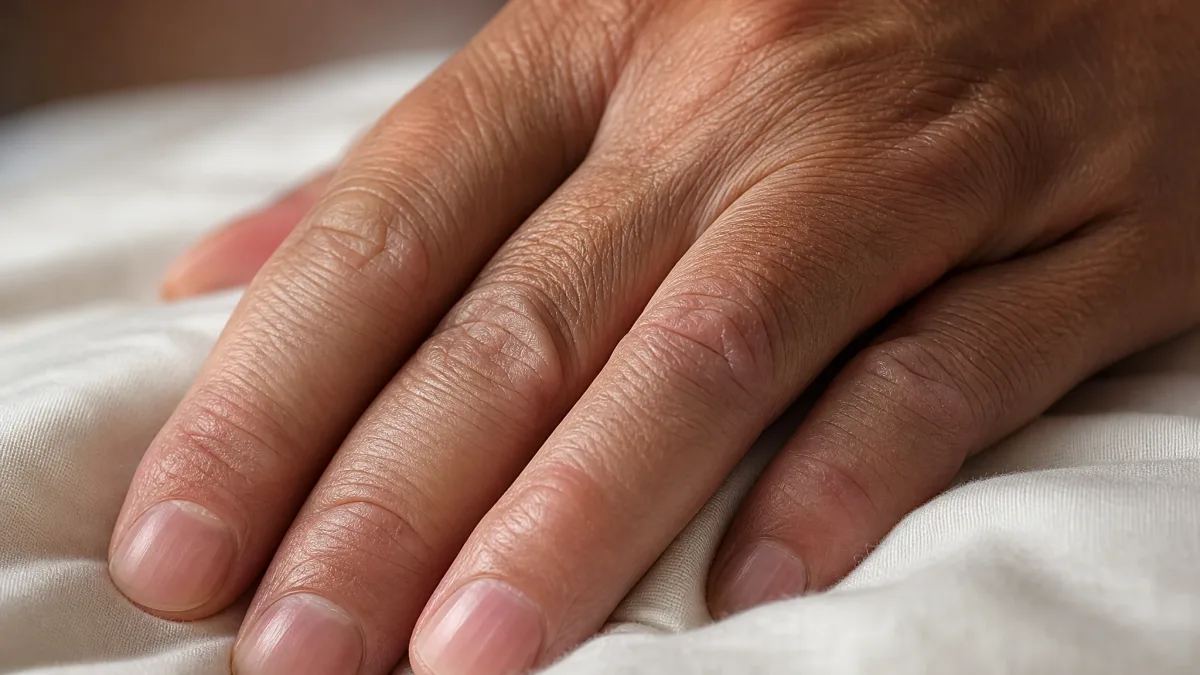
You catch your reflection in the bathroom mirror on a Tuesday morning and freeze at the diagonal crease cutting sharp across your cheek.
It takes a full hour of washing and moisturizing for that stubborn line to finally soften, leaving you to wonder why gravity and your bedding conspired against your skin overnight. While standard daytime facial expressions create temporary dynamic lines from smiling or squinting, the pillow leaves behind something far more structurally significant.
Decades of repetitive nocturnal mechanical distortion gradually etch those temporary morning impressions into permanent fixtures of your facial architecture.
The Physics of the Pillow: Compression, Friction, and Shear Stress

Pressing half your face into a standard cotton pillowcase every single night subjects delicate facial skin to continuous mechanical shear stress.
As you shift and breathe during your six to eight hours of rest, the surface friction of traditional bedding pulls, folds, and stretches the skin repeatedly in asymmetric directions. This lateral compression restricts local microcirculation precisely when your face needs uninterrupted nutrient delivery.
Structural dermal proteins like collagen and elastin respond very differently to chronic nighttime distortion than they do to brief daytime muscular contractions.
⚠️ COMMON MISTAKE
Ignoring Morning Creases
Brushing off recurring morning sleep lines as harmless is a mistake. When a crease takes longer to fade than it used to, your dermal matrix is losing its elastic recoil.
Side Sleeping vs. Back Sleeping Mechanics
Side Sleeping
- High facial compression against pillow
- Unilateral deepening of nasolabial folds
- Accelerated crow's feet on preferred side
- Constant nocturnal skin stretching
Back Sleeping
- Zero mechanical contact with bedding
- Symmetric distribution of facial tissue
- Unrestricted microcirculation overnight
- Preserved dermal structural integrity
The Night Shift: What Your Skin Actually Does While You Sleep

Cellular repair peaks between midnight and four in the morning, launching an intensive cycle of mitotic division, increased blood flow, and accelerated turnover.
Prolonged pillow compression creates mechanical road blocks that choke off local blood flow, directly interfering with essential nutrient delivery and metabolic waste clearance during these critical recovery windows. When your skin cannot efficiently clear cellular debris or synthesize fresh extracellular matrix proteins due to physical restriction, repair quality suffers.
Chronic nocturnal friction gradually compromises the skin barrier's natural moisture retention capabilities, leaving tissue more vulnerable to environmental aging factors long after you wake up.
🌙 The 8-Hour Nocturnal Skin Repair Cycle
Midnight Onset
Cellular mitotic division accelerates across all dermal layers.
Peak Blood Flow
Microcirculation increases to deliver vital nutrients and repair factors.
Matrix Synthesis
Fibroblasts actively produce fresh collagen and support proteins.
Morning Recovery
Barrier function resets, though compression creases begin to set.
The Dermatological Consensus: Side Versus Stomach Versus Back

Stomach sleeping forces the head into an extreme rotational angle for hours at a time, resulting in deep vertical forehead lines and heavily compressed nasolabial folds.
Side sleeping creates pronounced facial asymmetry, with chronic unilateral pressure deepening crow's feet and cheek wrinkles on whichever side you favor most. Clinical observations consistently show more advanced aging signs on a patient's preferred sleeping side compared to the opposite cheek.
Back sleeping remains the gold standard for mechanical skin preservation because it completely eliminates direct facial contact with bedding surfaces.
The Side-Sleeping Asymmetry Effect — At a Glance
⏱️ Exposure Time
6 to 8 hours nightly
📉 Primary Impact
Unilateral wrinkle depth
🔍 Common Area
Outer orbital and cheekbones
⚠️ Risk Factor
Cumulative collagen fatigue
The Core Issue
Repeated mechanical distortion breaks down local elastic fibers faster than nocturnal repair cycles can rebuild them.
The Turning Point: Where Clinical Research and Real Life Meet

Forcing yourself into strict back-sleeping for the rest of your life is rarely realistic and often wrecks your overall sleep quality.
Chronic sleep deprivation spikes cortisol production, which breaks down skin collagen far faster than a stray pillow crease ever could. Dermatologists emphasize that managing nighttime surface friction and mechanical shear is often far more sustainable than attempting a total, miserable posture overhaul.
The goal is not absolute architectural perfection across eight unconscious hours, but rather strategic mitigation to protect your delicate facial matrix over thousands of nights.
💡 PRO TIP
Prioritize Friction Reduction
If you cannot break your side-sleeping habit, focus entirely on eliminating pillow friction. Smooth fabrics reduce mechanical pull by over seventy percent.
The Architectural Defense: Modifying Your Sleep Environment

Traditional cotton or feather pillows bunch up easily, creating high-pressure pockets that maximize facial distortion throughout the night.
Upgrading to high-grade mulberry silk or smooth satin pillowcases drastically reduces surface friction, allowing your skin to glide smoothly across the fabric instead of catching and folding. Specialized ergonomic pillows featuring carved side cutouts or cervical neck rolls further cradle the head while keeping the cheekbones suspended off the pressure surface.
Pairing these pillows with supportive body wedges helps gently train your body to maintain a stable, low-friction tilt or secure back-sleeping position without waking up sore.
Best Bedding Upgrades
Nighttime Skin Protection Verdicts
- 🟢 Switching to Silk Pillowcases — Dramatically cuts surface friction and mechanical shear stress.
- 🟡 Forcing Strict Back Sleeping — Effective if sustainable, but harmful if it causes chronic sleep deprivation.
- 🔴 Stomach Sleeping on Cotton — Maximizes facial compression and accelerates permanent wrinkle formation.
Key Sleep Mechanics Facts
Bedside Setup Audit
Nighttime Defense Hierarchy
Prioritizing your skin protection strategy from foundation to advanced tips
Frequently Asked Questions
Can anti-wrinkle creams reverse sleep lines?
Topical retinoids and peptides effectively support overall collagen synthesis and skin texture, but they cannot stop physical nightly folding if mechanical pressure continues unabated.
Does the side I sleep on really make my face asymmetrical?
Dermatologists frequently observe pronounced one-sided aging in patients who consistently sleep on the same side for decades, matching the exact pressure patterns of their pillows.
Are silk pillowcases scientifically proven to prevent wrinkles?
Silk does not possess magical anti-aging compounds, but its ultra-smooth surface dramatically cuts friction and mechanical shear stress compared to traditional rough cotton.
How long does it take for a morning sleep crease to become permanent?
Morning lines typically fade quickly in younger skin, but cumulative matrix fatigue over thousands of nights eventually converts transient creases into permanent structural wrinkles.
How can a stomach sleeper safely transition to back sleeping?
Gradual positioning is key. Place supportive body pillows alongside your torso and use a cervical neck roll to make back-sleeping comfortable enough to maintain through the night.
Engineering Your Nightly Defense
Time and genetics naturally dictate much of how our skin ages, but nocturnal mechanical shear remains a fully controllable variable within your daily routine.
Audit your bedside setup tonight by swapping out high-friction cotton for smooth silk, adjusting your head support to minimize direct cheek compression, and easing into a lower-friction posture. Protect your skin's collagen architecture from unnecessary wear so you can wake up ready to face the day without the mirror shock.

Meet Edward Green, the founder of GolfingGoal and a seasoned expert in golf. With years of experience on the course and a passion for the sport, Edward has a wealth of knowledge to share. As our Lead Writer, he contributes articles, tutorials, and resources to help readers to improve their skills and reach their full potential on the golf course. Join Our Team!