
You reach the top of your basement stairs carrying a load of laundry and your right knee gives a sharp, unexpected pinch.
You did everything right at the gym this week, lifting with good intentions, yet your joints feel older than your calendar says.
Staying strong after 55 is non-negotiable for longevity, but the margin for mechanical error narrows significantly past mid-life.
⚠️ COMMON MISTAKE
Stop Pushing Through Joint Grinding
Treating joint pain as a badge of honor after 50 accelerates cartilage wear. Swap high-impact friction for smooth, controlled resistance profiles.
The Biology of the Over-55 Joint and Why Mechanics Change

Aging cartilage experiences a natural decline in water retention and shock absorption capacity.
This reduction strips away the built-in biological buffer between your bones.
At the same time, your tendons lose elasticity because collagen fibers stiffen up with age.
This slower response profile means your connective tissue cannot bounce back from high-velocity impact the way it did at 30.
Joint Tissue Metrics Across Decades
How physiological capacity shifts past mid-life
Exercise 1 to Skip: The Behind-the-Neck Lat Pulldown
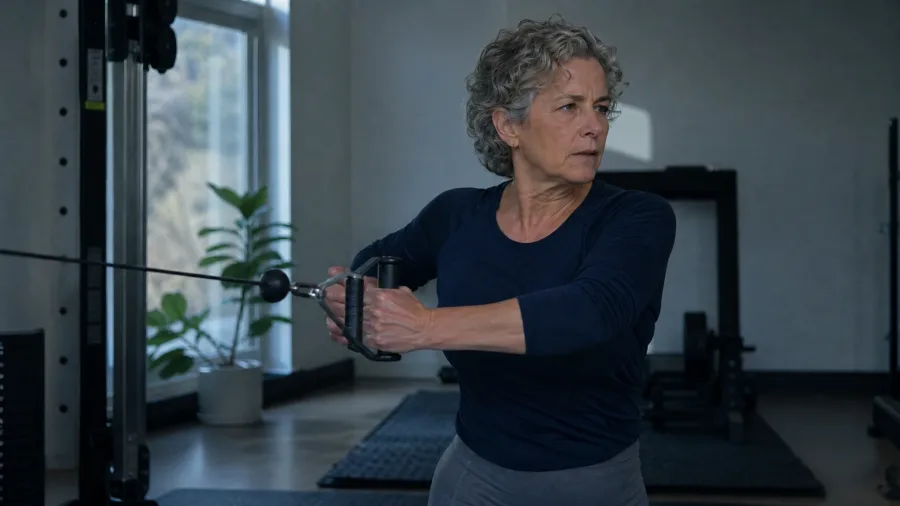
Taking a barbell or a lat pulldown bar behind your neck forces your shoulder joint into extreme external rotation and abduction.
This awkward mechanical path compromises your rotator cuff and sets up a collision course inside the joint space.
Orthopedic surgeons frequently repair labral tears and treat severe impingement syndrome in mature shoulders caused by this exact movement.
Switch immediately to front-rack cable pulldowns or neutral-grip movements that keep your shoulders in a stable, natural plane.
Shoulder Joint Stress Spectrum
Ranking pressing mechanics by rotator cuff wear risk
- Neutral Landmine Press: Optimal alignment preserving subacromial space.
- Standard Overhead Dumbbell Press: Moderate load on stabilizers, manageable with good form.
- Behind-the-Neck Barbell Press: Severe impingement risk and extreme labral stress.
Exercise 2 to Skip: Unsupported High-Impact Box Jumps

Explosive landing forces multiply your body weight exponentially across your patellofemoral joints and your lumbar spine.
After 55, this sharp shock load dramatically increases your personal risk of meniscus tears and microscopic stress fractures.
Slower neuromuscular reaction times at this stage of life also mean you are more likely to misland or roll an ankle.
Build lower-body power safely instead by using heavy kettlebell deadlifts, weighted sled pushes, or controlled incline treadmill walking.
💡 PRO TIP
Swap Plyometrics for Concentric Power
You can build explosive leg drive without leaving the floor. Try heavy trap-bar deadlifts or loaded sled drags to spare your knees.
Exercise 3 to Skip: Deep Heavy Barbell Back Squats

Heavy axial loading combined with natural thoracic stiffness often forces your lower back to round at the bottom of a deep squat.
This subtle lumbar flexion places intense shearing stress directly on your spinal discs.
Reduced ankle mobility past 55 makes matters worse by forcing your knees forward to compensate.
Protect your spine and hips by switching to goblet squats to a box or safety-bar box squats that keep your torso upright.
Goblet Box Squat — At a Glance
⏱️ Tempo
3 seconds down, 1 second pause
📅 Frequency
2 to 3 times per week
💪 Targets
Quads, glutes, core stability
⚠️ Skip If
Sharp hip impingement occurs
Form Key
Sitting back onto a box removes momentum and protects knee cartilage.
Exercise 4 to Skip: Unstable-Surface Single-Leg Work

Standing on unstable apparatuses like Bosu balls does not build functional strength for mature adults.
Instead, it compromises force production and spikes your risk of rolling an ankle or tweaking a knee.
Orthopedic specialists prefer solid-ground balance training because it lets you recruit maximum muscle fibers safely.
Build rock-solid stability instead by practicing bodyweight single-leg Romanian deadlifts or supported split squats on firm flooring.
Best Alternatives for Balance
Safe Loading Sequence
The Orthopedic Consensus on Joint Preservation and Strength
Strip away the fitness industry noise and joint specialists all land on the exact same strategy.
Strength training after 55 is essential for metabolic health, but it demands mechanical alignment and adequate recovery windows.
Prioritize tension over velocity by moving your weights with deliberate control rather than relying on momentum.
Emphasize eccentric control during the lowering phase to build lasting tendon resilience without joint degradation.
Sample Joint-Safe Weekly Routine
Which Camp You're In: A Quick Self-Check Audit

Run every exercise in your current routine through a simple three-question audit.
Does the movement cause joint grinding, or can you stop mid-repetition without losing control?
If an exercise relies entirely on momentum or stability gimmicks, drop it immediately.
Empower yourself to trade ego-lifting for sustainable longevity metrics that protect your independence.
Joint-Safe vs. High-Risk Movement Choices
Joint-Sparing Choices
- Goblet squats to a secure box
- Landmine presses for shoulder safety
- Solid-ground single-leg deadlifts
- Controlled cable pulldowns to the front
High-Risk Habits
- Deep barbell squats with poor ankle mobility
- Behind-the-neck lat pulldowns
- Plyometric box jumps on hard surfaces
- Unstable Bosu ball lower-body lifts
Exercise Selection Verdicts
- Cable Rows & Landmine Presses — Safe, stable mechanical paths protecting joint health.
- Standard Dumbbell Squats & Lunges — Requires careful depth regulation and solid footwear.
- Behind-the-Neck Presses & Box Jumps — High shear stress and unnecessary injury risk.
🛡️ Your 4-Step Joint Protection Blueprint
Audit
Remove high-impact and behind-the-neck movements from your weekly sessions.
Substitute
Replace risky lifts with cable machines, landmines, and box squats.
Ground
Shift all balance training from unstable pads to firm, solid flooring.
Recover
Allow a full 48 to 72 hours of rest between heavy connective tissue sessions.
Frequently Asked Questions
Can I still build muscle after 55 if I avoid heavy barbell lifts?
Yes. Hypertrophy relies on mechanical tension and proximity to failure, which you can achieve safely using machines, cables, and moderate weights with controlled tempos.
How do I know the difference between normal muscle soreness and joint injury?
Muscle soreness presents as a dull ache across the belly of the muscle 24 to 48 hours post-workout. Joint injury feels like sharp, localized pain or grinding during the actual movement.
Are running and jogging considered safe after 55?
It depends on your personal joint history and running mechanics. Many active adults transition successfully to incline treadmill walking or cycling to spare their knees from repetitive impact.
How many days of recovery do joints need compared to muscles?
Connective tissue has a significantly lower blood supply than skeletal muscle. Because of this slower biological delivery system, tendons and ligaments often require 72 hours to fully recover.
Building a Body That Lasts a Lifetime
Protecting your joints after 55 is not about doing less work in the gym. It is about training with intelligence so you can stay active for decades to come.
Drop the ego-lifting, swap out the high-shear movements, and commit to a sustainable routine that respects your body's mechanics.

Meet Edward Green, the founder of GolfingGoal and a seasoned expert in golf. With years of experience on the course and a passion for the sport, Edward has a wealth of knowledge to share. As our Lead Writer, he contributes articles, tutorials, and resources to help readers to improve their skills and reach their full potential on the golf course. Join Our Team!