
You reach the gym floor wanting to stay strong, but standard fitness advice often feels punishing rather than restorative for knees and shoulders over 50.
Traditional trainers often push high-impact ranges that ignore how aging connective tissue actually handles shear stress.
Physical therapists look at gym equipment through a lens of strict longevity, intentionally avoiding movements that accelerate cartilage wear.
Here are six specific exercises and habits clinical experts skip entirely, along with the smarter alternatives they use instead.
💡 PRO TIP
The Core Clinical Philosophy
Joint preservation is the absolute prerequisite for lifelong strength. Protecting cartilage today means you can keep lifting tomorrow.
Why Traditional Gym Advice Breaks Down After 50
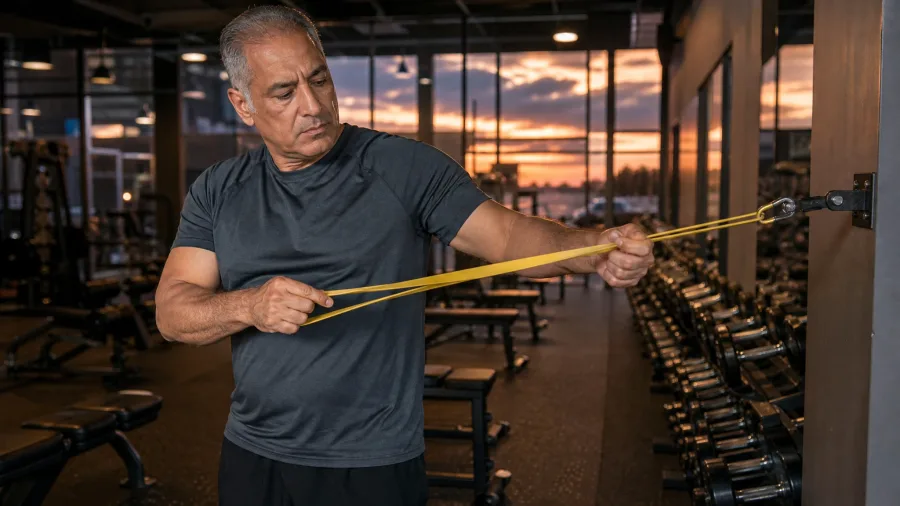
Your body handles mechanical load differently today than it did thirty years ago.
Tendon vascularity decreases with age, meaning micro-tears from high-velocity or awkward vector forces take much longer to repair.
Standard bodybuilding programs assume an indestructible frame that absorbs poor joint angles without consequence.
Understanding joint mechanics changes how you program every single session, letting you build muscle without paying for it with joint pain.
1. Never Do Heavy Behind-the-Neck Lat Pulldowns or Presses
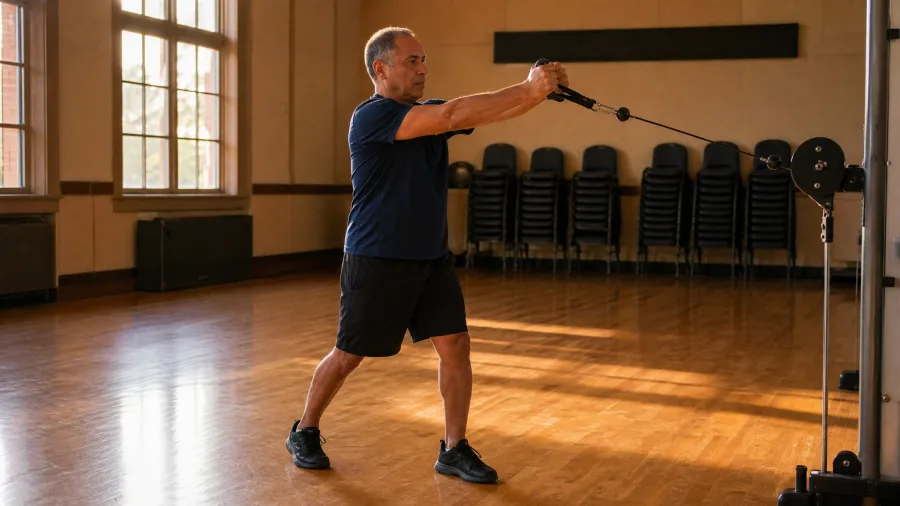
Behind-the-neck pressing forces your shoulder joints into extreme external rotation and abduction.
This vulnerable angle pinches the supraspinatus tendon directly against the acromion process.
Physical therapists skip this movement because it invites chronic rotator cuff impingement and micro-tears.
Switch to front-facing cable pulldowns or vertical landmine presses that respect your natural scapular plane.
💡 Tip: Keep your elbows slightly forward of your torso during any pressing movement to spare your shoulder capsules.
Shoulder Movement Safety Guide
- 🟢 Vertical Landmine Press — Follows the natural scapular plane without pinching tendons.
- 🟡 Standard Barbell Overhead Press — Acceptable only with strict mobility and a moderate load.
- 🔴 Behind-the-Neck Press — Directly impinges the rotator cuff under high mechanical load.
2. Never Skip the Deceleration Phase on Weight Stacks
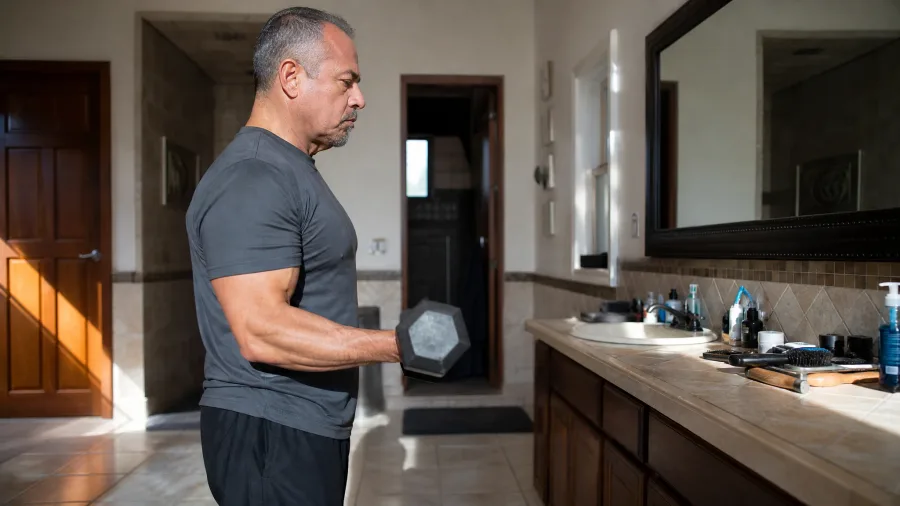
Letting weight stacks slam or dropping dumbbells abruptly robs your muscles of the critical eccentric phase.
The lowering portion of a lift is where true functional strength and tendon stiffness are built.
Rapid directional changes create sharp shock loads on aging articular cartilage and unconditioned tendon junctions.
Use a strict 3-second eccentric drop to stimulate neuromuscular adaptation safely.
⏱️ The 3-Second Repetition Breakdown
Concentric Lift
Drive the weight upward with controlled power for one second.
Isotropic Hold
Pause briefly at peak contraction without losing tension.
Eccentric Drop
Lower the weight slowly over three full seconds to build tendon strength.
3. Never Perform Heavy Spinal Flexion Under Load

Full weighted sit-ups and heavy cable crunches place intense anterior compressive stress on your intervertebral discs.
Your lumbar spine is engineered primarily for stability and anti-rotation, not repetitive bending under weight.
Physical therapists prefer spine-sparing core work that trains the trunk to resist movement rather than create it.
Swap crunches for hollow-body holds, dead bugs, or loaded farmer's carries.
4. Never Lock Out the Knees on Leg Presses or Squats

Hyperextending your knees at the top of a leg press turns off your quadriceps entirely.
The entire load instantly shifts onto your cruciate ligaments, menisci, and patellofemoral cartilage.
Cartilage repair slows significantly with age, making passive joint-locking a fast track to osteoarthritis flare-ups.
Maintain a soft knee bend on every single repetition to keep constant tension on active muscle tissue.
💡 Tip: Stop three inches short of full extension to keep the load squarely on muscle tissue where it belongs.
⚠️ COMMON MISTAKE
The Knee Lock Trap
Resting between reps with locked knees forces passive ligaments to bear the weight. Keep your muscles engaged through the entire set.
5. Never Use Momentum to Overcome Fatigue
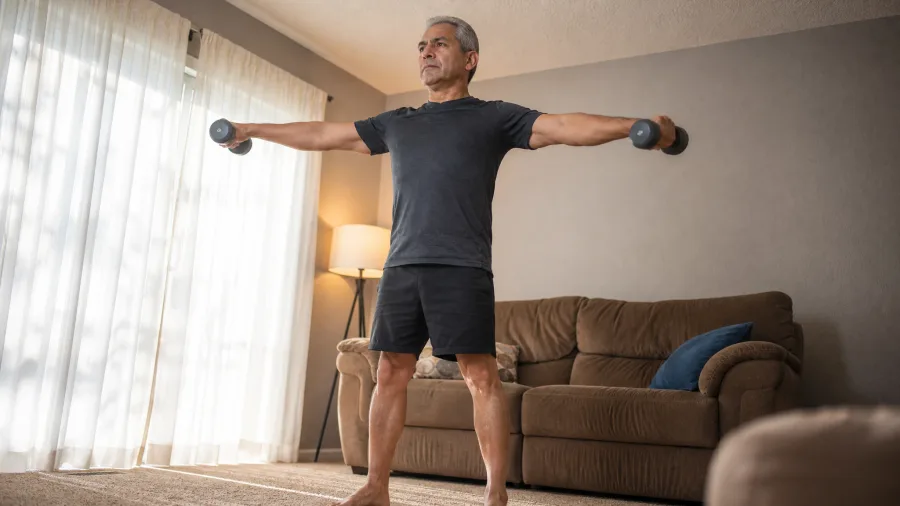
Swinging heavy weights shifts tension away from your target muscles and directly onto vulnerable spine and shoulder joints.
Using body English creates dynamic shock loads that loose connective tissue cannot safely absorb.
Physical therapists recommend dropping your working weight by twenty percent to eliminate momentum completely.
Strict tempos ensure true muscular isolation without risking tendon strains.
Momentum Risk Spectrum
How swinging heavy weights escalates joint and tendon strain
- Strict Tempo (0% Sway): Pure muscular tension with maximum safety for joints.
- Minor English (15% Sway): Shifts load to connective tissue and reduces muscle activation.
- Full Body Swing (50%+ Sway): High shear stress on lumbar spine and elbow tendons.
6. Never Ignore Persistent Joint Pain as Normal Aging
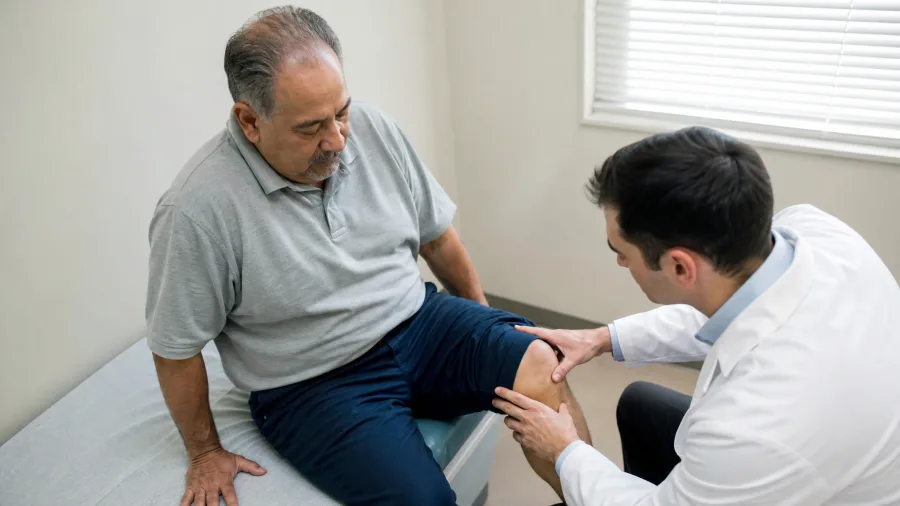
Dismissing sharp joint aches as a mandatory tax of getting older is a dangerous clinical mistake.
Delayed onset muscle soreness resolves within seventy-two hours, while intra-articular joint pain worsens under load.
Sharp or grinding sensations are clear warning signs of mechanical malalignment or excessive shear stress.
Modify or drop any exercise immediately when joint lines protest.
Pain Audit Protocol
Longevity Training Metrics
The vital statistics behind smart joint preservation after 50
The Gym Floor Contrast
Old-School Bodybuilding
- Behind-the-neck presses
- Slamming weight stacks
- Weighted spinal crunches
- Locked-out knee extensions
- Swinging heavy weights
Physical Therapist Standard
- Vertical landmine presses
- Controlled 3-second eccentric drops
- Spine-neutral dead bugs
- Soft-knee active tension
- Strict tempo isolation
Frequently Asked Questions
Is it too late to start strength training after 50?
Muscle tissue responds to progressive resistance at any age. Cellular protein synthesis remains fully active, though recovery takes slightly longer between sessions.
How do I know the difference between muscle burn and joint pain?
Muscle burn is a localized metabolic fatigue that fades quickly with rest. Joint pain is sharp, deep, or pinching, and often lingers long after your workout ends.
Should older adults avoid free weights entirely in favor of machines?
Not necessarily. Free weights build crucial stabilizer strength, provided you maintain strict form, control the tempo, and avoid extreme joint angles.
How often should a physical therapist evaluate a fitness routine?
An annual movement screening helps catch minor biomechanical imbalances before they turn into acute injuries or chronic joint degeneration.
Building a Bulletproof Routine for the Decades Ahead
Protecting your joints is the ultimate accelerator for long-term fitness gains and physical freedom.
Small, intentional shifts in form and tempo will keep you lifting strong for decades without stepping off to deal with injuries.
Take these adjustments into your next gym session and experience what true training longevity feels like.

Meet Edward Green, the founder of GolfingGoal and a seasoned expert in golf. With years of experience on the course and a passion for the sport, Edward has a wealth of knowledge to share. As our Lead Writer, he contributes articles, tutorials, and resources to help readers to improve their skills and reach their full potential on the golf course. Join Our Team!